Creative Briefing
Creative briefing and feedback
Build a creative brief around an audience decision, review the finished impression and resolve feedback while preserving claim limits.
A creative brief should state who needs to understand what, why the message is supportable and what the audience can do next. Feedback should judge the finished work against those decisions. Together they give writers, designers and approvers a shared basis for decisions without prescribing every execution in advance.
Agree on the job
Describe the audience through the decision they face. Someone checking whether a service operates in their area needs different information from someone comparing two service packages. State the question this creative answers and the next step it invites.
| Field | Decision |
|---|---|
| Audience situation | What is the person trying to decide? |
| Communication job | What should this execution help them understand? |
| Support | Which current product detail, demonstration or service term backs the message? |
| Next step | What will the destination let them inspect or do? |
| Claim limits | What must the work avoid suggesting? |
| Decision owner | Who resolves conflicting comments and approves the final execution? |
Keep formats, dates and asset requirements in the brief, but settle the communication job before debating headlines or layouts. A team cannot judge whether an execution works if reviewers expect it to answer different questions.
Brief fields: the decisions to settle first
- Audience situationWhat is the person trying to decide?
- Communication jobWhat should this execution help them understand?
- SupportWhich current product detail, demonstration or service term backs the message?
- Next stepWhat will the destination let them inspect or do?
- Claim limitsWhat must the work avoid suggesting?
- Decision ownerWho resolves conflicting comments and approves the final execution?
Set the approval route before production
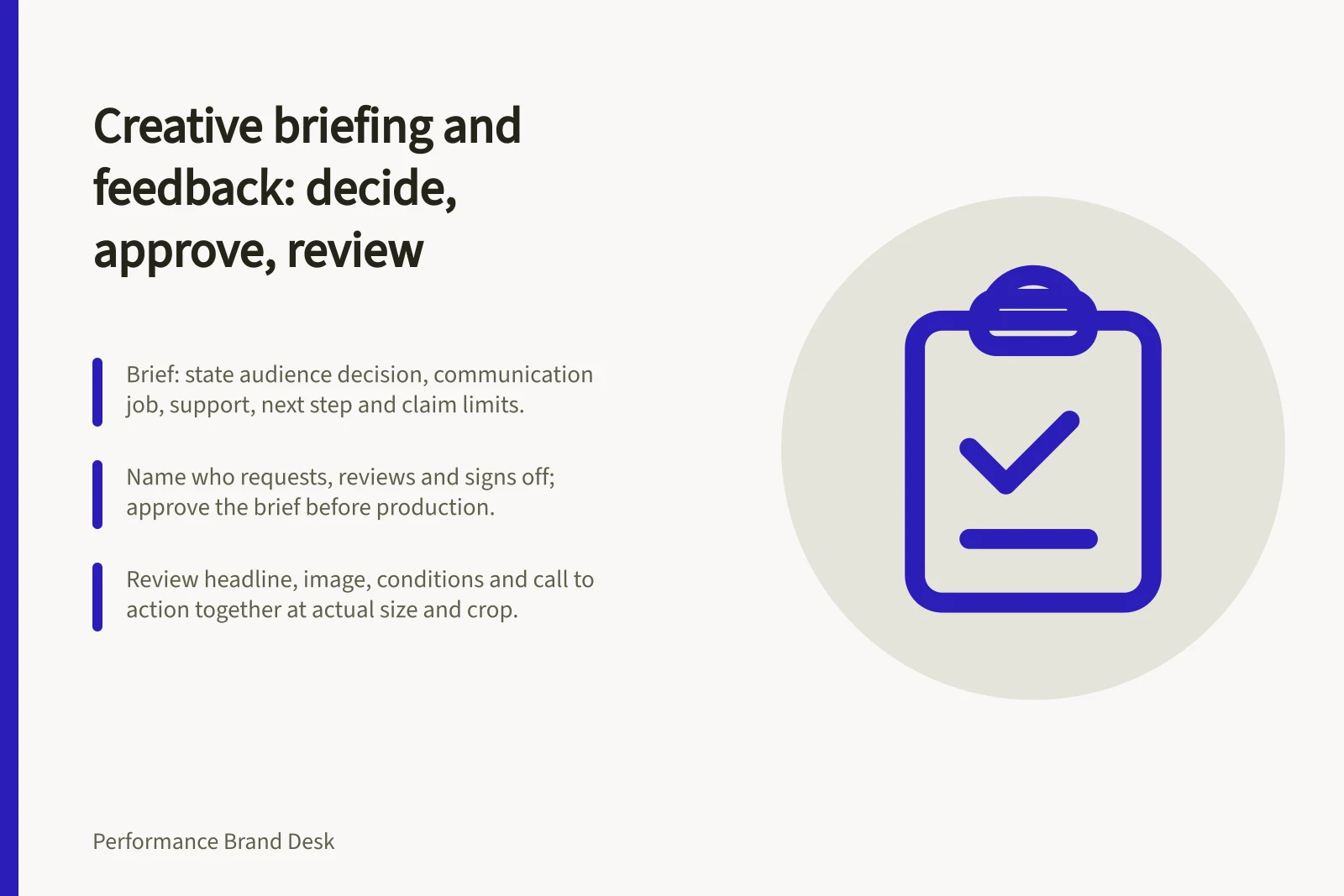
Name who requests the work, who reviews it and who holds final sign-off authority. Reviewers identify issues against the agreed criteria; the final approver resolves competing recommendations. Confirm this route when the project is initiated so the team knows who can approve the brief and the finished execution.
Agree and formally approve the brief before production begins. Treat it as the shared record of the project’s objective, audience, deliverables and approval requirements. If those decisions change, update the brief rather than relying on conflicting instructions in separate conversations.
Make each deliverable specific enough to hand over: record its channel, format, dimensions, resolution, file type and platform requirements. Set dates for key milestones — first draft, approval checkpoint, final delivery and go-live — so reviewers know when their decisions are needed.
Record the project name and brand or product alongside the requester and approvers. These details distinguish the work in review queues and keep the right people connected to decisions when several projects are under way.
The approval route, from brief to sign-off
- Confirm the routeName who requests the work, who reviews it and who holds final sign-off authority
- Approve the briefFormally approve the objective, audience, deliverables and approval requirements before production begins
- Review against criteriaReviewers identify issues against the agreed criteria
- Resolve and sign offThe final approver resolves competing recommendations
Milestones to date in the brief
- First draft
- Approval checkpoint
- Final delivery
- Go-live
Review the whole execution
Give the creative team room to propose different ways of answering the same audience question. Review the headline, image, visible conditions and call to action together, at the size and crop in which the ad may appear. Follow the proposed next step to see whether the destination provides what the ad leads people to expect.
For Australian advertising, the ACCC accepts reports about possible misleading or false claims and uses them to inform education, compliance and enforcement work. It can require businesses to back up product or service claims, but it does not resolve individual disputes or provide legal advice.
If reviewers disagree about what viewers may understand, record the competing interpretations. A separate, neutral comprehension check may help investigate them. An informal check can expose confusion; it cannot show how common that interpretation is in the market or predict sales.
What the ACCC can and cannot do about a claim
- Accepts reports about possible false or misleading claims and uses them to inform education, compliance and enforcement workCan
- Require businesses to back up product or service claimsCan
- Resolve individual disputesCannot
- Provide legal adviceCannot
Turn comments into a decision
Ask reviewers to identify the concern and its consequence. “Make it bolder” leaves the team guessing; “The service-area condition disappears in this crop, so the ad may imply wider coverage” identifies an issue to resolve. Correct factual errors, investigate unsupported impressions and label personal preferences as preferences.
Give one owner responsibility for reconciling comments. Record the concern, the brief criterion or evidence used, the decision and who must act. Establish disputed product facts before sending conflicting instructions to the creative team. Make a local correction if it preserves the central idea; if the idea depends on a promise the business cannot support, return to the brief.
Turning a preference into a decision
- Comment that leaves the team guessing“Make it bolder”
- Comment that names the concern and its consequence“The service-area condition disappears in this crop, so the ad may imply wider coverage”
Hand over the approved execution
Keep the final brief, exact assets and destinations, supporting claim records, material limits, open questions and approval owner together. State which kinds of change need another review. A new crop can alter the apparent promise if it hides a condition; a new benefit or comparison changes the claim more directly.
After launch, record which version ran and what the available response data show. A click does not establish that people understood the message, and a few favourable comments do not establish campaign performance. Use each finding within its measured limits when writing the next brief.
Keep the approval record with the final version, including the approver and any conditions attached to sign-off. If a requested change falls outside the approved brief or deliverables, send it back through the agreed decision route before updating the execution.
The handover pack to keep with the approved execution
- Final brief
- Exact assets and destinations
- Supporting claim records
- Material limits
- Open questions
- Approval owner
In this guide
- Writing a brief with one communication jobDefine one audience takeaway, its support, a suitable next step and material limits before asking for ad concepts.
- Giving feedback tied to the intended audience responseWrite actionable creative comments by comparing the brief’s intended takeaway with the possible impression of the finished ad.
- Preventing committee feedback from removing the central ideaAssign review responsibilities, reconcile conflicting comments and preserve a supportable central idea.
- Documenting approved claims for creative teamsBuild a production-ready claim record with approved expressions, evidence, coverage, limits and change rules.