Creative Briefing
Part of Creative strategy reviews
Building a creative learning report for brand and growth teams
Structure a creative learning report around the decision, reviewed assets, observed outcomes, uncertainty and next owner.
A creative learning report should make the next decision traceable. Put the proposed action first, show the creative and evidence behind it, state what remains uncertain and assign an owner. Brand meaning and customer response belong in the same report, with their measures kept distinct.
Lead with the decision
Give the campaign and review dates, audience, offer, exact asset versions, destination and primary outcome. Then state whether the team proposes to retain, refine, replace or investigate. If no decision is supportable, name the missing record.
Brand reviewers need the intended takeaway, advertiser identification and claim limits. Growth reviewers need the defined customer action, delivery and response quality. Present those views beside each other without turning them into one score.
Report section / Minimum useful content
- Intended job
- Buyer question, intended takeaway and invited action
- What ran
- Asset versions, placements, audience, offer and destination
- What was observed
- Defined outcome, delivery context and any available comprehension finding
- What is uncertain
- Missing records, changed conditions and claims the method cannot support
- Decision
- Action, owner, next review point and evidence needed
Brand vs Growth Review Perspectives in Creative Learning Reports
- Brand Review Focus
- Intended takeaway, advertiser identification, claim limits
- Growth Review Focus
- Defined customer action, delivery quality, response quality
Label findings by what they are
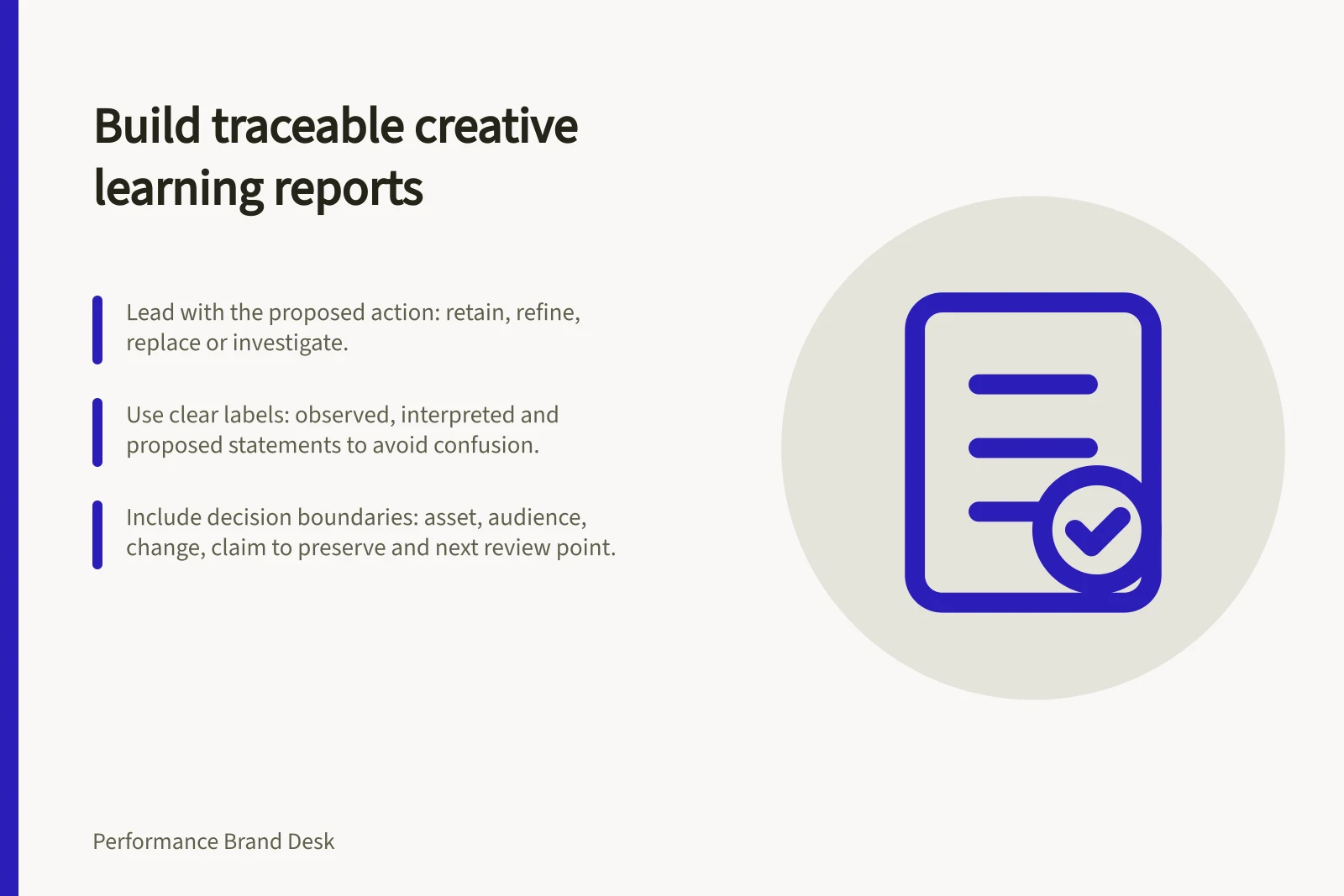
Separate observed, interpreted and proposed statements. An observed statement reports a defined result from an available record. An interpretation explains what the team thinks might account for it. A proposal specifies what to do next. Do not present the latter two as measurements.
For Google Ads conversions, record the conversion action, attribution setting, reporting period and extraction date. Recent figures may change as later actions arrive. Indicate when another read is needed, and do not call platform-credited conversions incremental sales without suitable comparison evidence.
For a comprehension finding, record who was asked, the question and how the creative was shown. A small informal check can flag ambiguity; it cannot establish its prevalence across the audience. If no check exists, label the intended takeaway as the brief’s objective, not an observed response.
Critical Data Points for Google Ads Conversions
- Conversion Action
- As defined in Google Ads setup
- Attribution Setting
- Last-click, data-driven, etc.
- Reporting Period
- Exact start and end date of measurement
- Extraction Date
- When data was pulled from platform
Show the decision’s boundary
A decision line should name the asset and audience, the change, the claim or condition to preserve, and the next check.
Refine asset B’s opening for the same audience and offer; keep the verified service-area condition visible in the delivered crop. This illustrates a report instruction, not an actual campaign finding.
The ACCC can require businesses to back up claims they make about their products or services, and may take compliance or enforcement action if a business misleads.
Include material counterevidence and changes during delivery. If response appeared in only one placement, say so. If the destination changed, record when. If later customer stages remain incomplete, set a review point.
Retain the brief, exact assets and source records under matching version labels so another team can reconstruct what the decision covers.