Creative Briefing
Part of Brand storytelling for direct response
Opening with a customer problem rather than company history
Write a customer-problem opening that leads quickly to a real product detail without overstating the customer's experience.
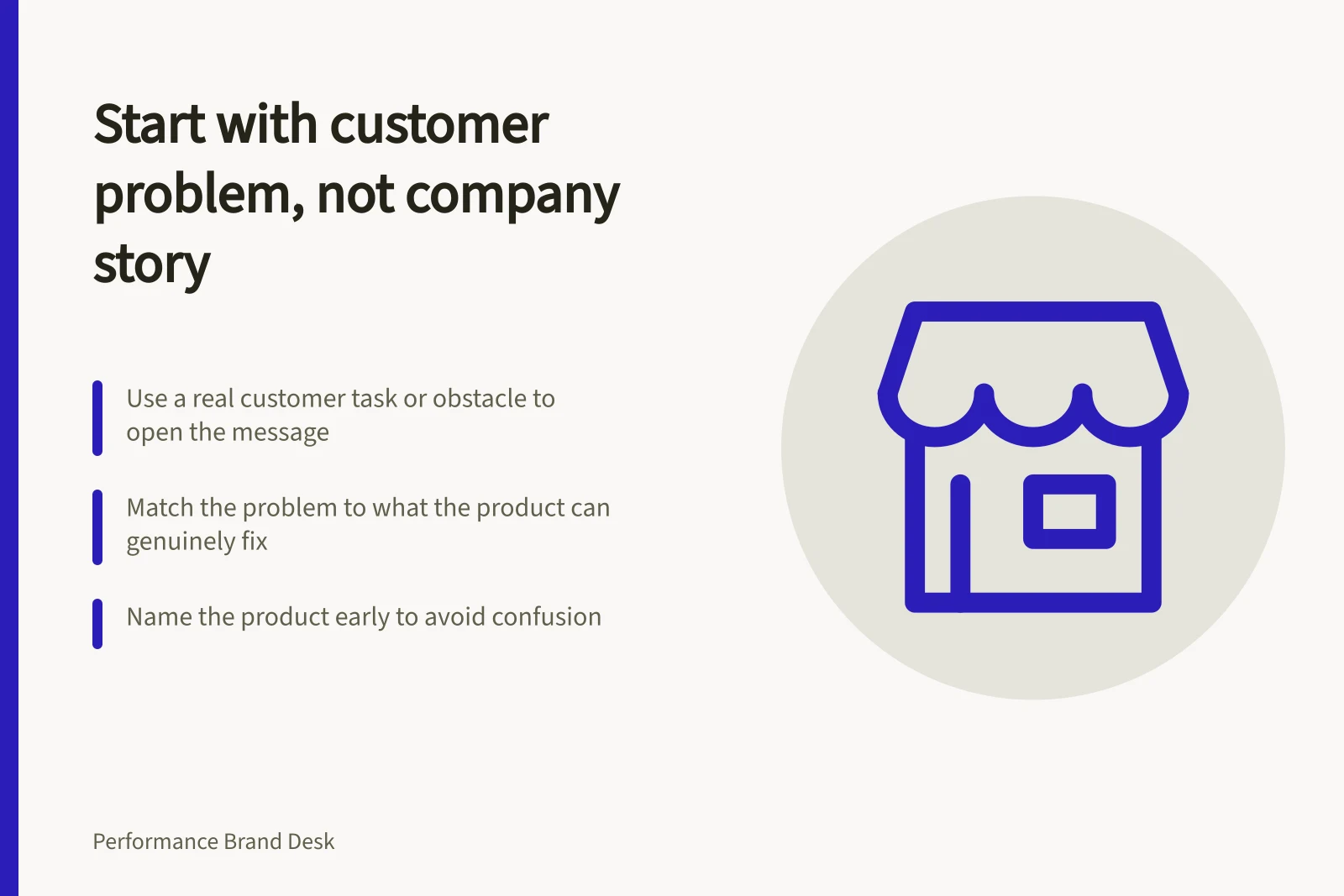
Open with a customer's task or obstacle when it helps them understand the offer. The first line should make the situation recognisable; company history can follow if it explains a relevant product choice.
Choose a problem the product addresses
The problem need not be dramatic. It might be a deep cupboard that makes tools awkward to reach, or a booking process with unclear steps.
Choose a situation the intended audience might recognise and the product can genuinely address. Avoid assigning feelings such as embarrassment or anxiety to every customer.
A useful drafting pattern is task → friction → product. For a fictional storage kit: “Need to reach the tools at the back of a deep cupboard? A fixed shelf can make that awkward.”
The next line should show what the kit does. This is a writing example, not evidence that the kit performs better than another product.
Keep the problem proportionate. A product that helps arrange items does not, by that fact alone, create a calmer home. The ACCC can require businesses to back up claims they make about their products or services.
Effective Problem-Opening Structure for Marketing Messages
- Identify a recognisable taske.g., reaching tools at the back of a deep cupboard
- Highlight the friction or obstaclee.g., awkward access due to fixed shelving
- Introduce the product as the solutione.g., pull-out tray that brings tools forward
- Confirm feature relevance and accuracyEnsure claims are substantiated; avoid overstating benefits (ACCC guidelines apply)
Regulatory Compliance in Product Claims (Australia)
- ACCC Authority
- Enforces truth in advertising under the Australian Consumer Law
- Claim Requirements
- All product claims must be substantiated and not misleading
- Common Pitfalls
- Overstating emotional benefits (e.g., 'creates a calmer home') without evidence
Hand the opening to the product
An opening can attract attention yet leave people unsure what is being sold. Name or show the product promptly, then explain the feature connected to the problem.
Two fictional openings:
- “Our founder spent years planning a better way to store tools.” The offer remains unclear.
- “When tools disappear behind a deep shelf, a pull-out tray brings them forward.” This identifies a possible solution, but its fit and load capacity would need checking for any real product.
The second suits this response brief better because it sets up a product explanation. That is an editorial judgement, not a tested performance result.
Read the first two lines alone. Can a reader recognise the task and identify what the product offers?
Then check whether the destination explains the feature the opening leads them to expect. If the connection is weak, narrow the problem or choose another opening.
Problem-Focused vs. Company-History Openings
- Weak Opening (Company Focus)Our founder spent years planning a better way to store tools.
- Strong Opening (Customer Problem)When tools disappear behind a deep shelf, a pull-out tray brings them forward.
- Key DifferenceThe second opening immediately connects the customer’s pain point to a tangible product feature.