Creative Briefing
Part of Creative briefing and feedback
Writing a brief with one communication job
Define one audience takeaway, its support, a suitable next step and material limits before asking for ad concepts.
Give one ad execution a communication job by completing this sentence: “After seeing this, the intended audience should understand ___ so they can ___.” The first blank is the takeaway; the second is the decision or next step.
If the sentence needs several unrelated answers, choose which one leads this execution.
Start with the decision in front of the audience
Describe the situation that might make someone pay attention now. “Prospective customers” gives little direction. “People checking whether a hire service has a suitable collection location” names a question the creative could answer, provided the business has current information about its locations.
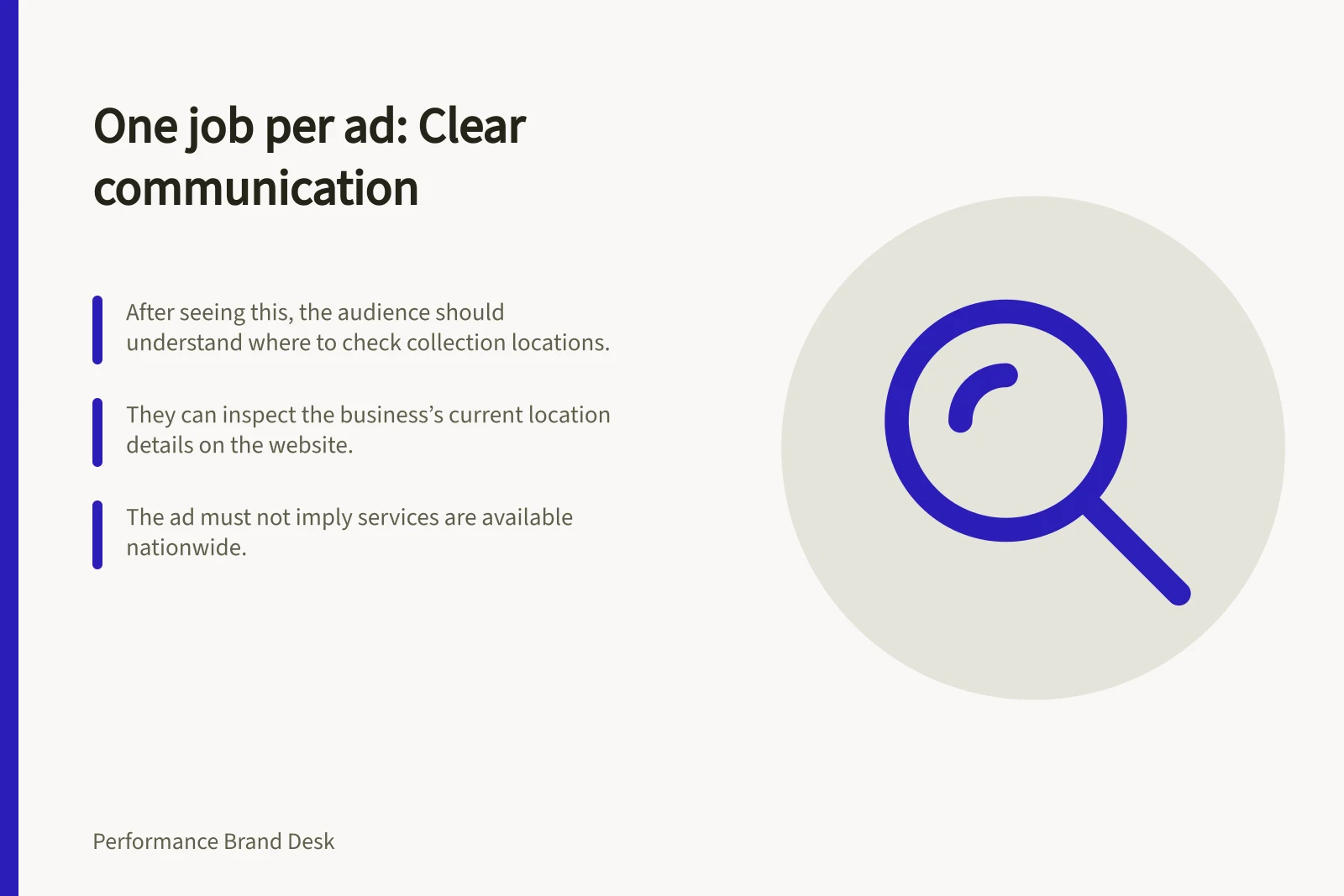
Write the job in ordinary language. “Increase confidence” is a hoped-for effect. “Explain where people can check collection locations before requesting a hire” tells the team what information to convey and suggests a suitable destination.
If research has not established that this question matters to the intended audience, mark it as an assumption to investigate.
This page addresses the takeaway for an individual execution. The broader choice between brand building and immediate response belongs in the campaign brief.
Put support and limits beside the job
Use four short lines in the working brief:
- Job:What should the person understand?
- Support:Which current detail backs that meaning?
- Next step:What can the person inspect or do?
- Limit:What must the ad avoid implying?
A service might operate only in certain locations; a demonstration might show only one product configuration. Put a material limit beside the proposed message so a bounded fact does not become a universal promise.
For Australian advertising, the ACCC can require businesses to back up claims they make about their products or services, and can investigate misleading conduct.
Format, dimensions, brand assets, launch date and production budget also belong in the brief. They constrain delivery, but they do not replace the decision about what this execution must communicate.
Resolve competing requests
If stakeholders ask one short ad to introduce the business, explain every service, answer eligibility questions and secure a booking, ask which understanding the proposed action requires first. Make that the leading job.
Move secondary detail to the destination or another execution only when the ad’s overall impression remains accurate.
Check the working brief
Ask a colleague who missed the discussion to read the brief and state the audience’s decision, intended takeaway, supporting detail, next step and claim limit. If their reading differs from the owner’s, settle the brief before requesting polished concepts.
If they cannot state all five, the brief is not ready.