Creative Testing
Part of Brand safety in performance messaging
Checking comparative claims before an ad test
Check the products, measures, dates and final wording behind an Australian comparative ad before testing it.
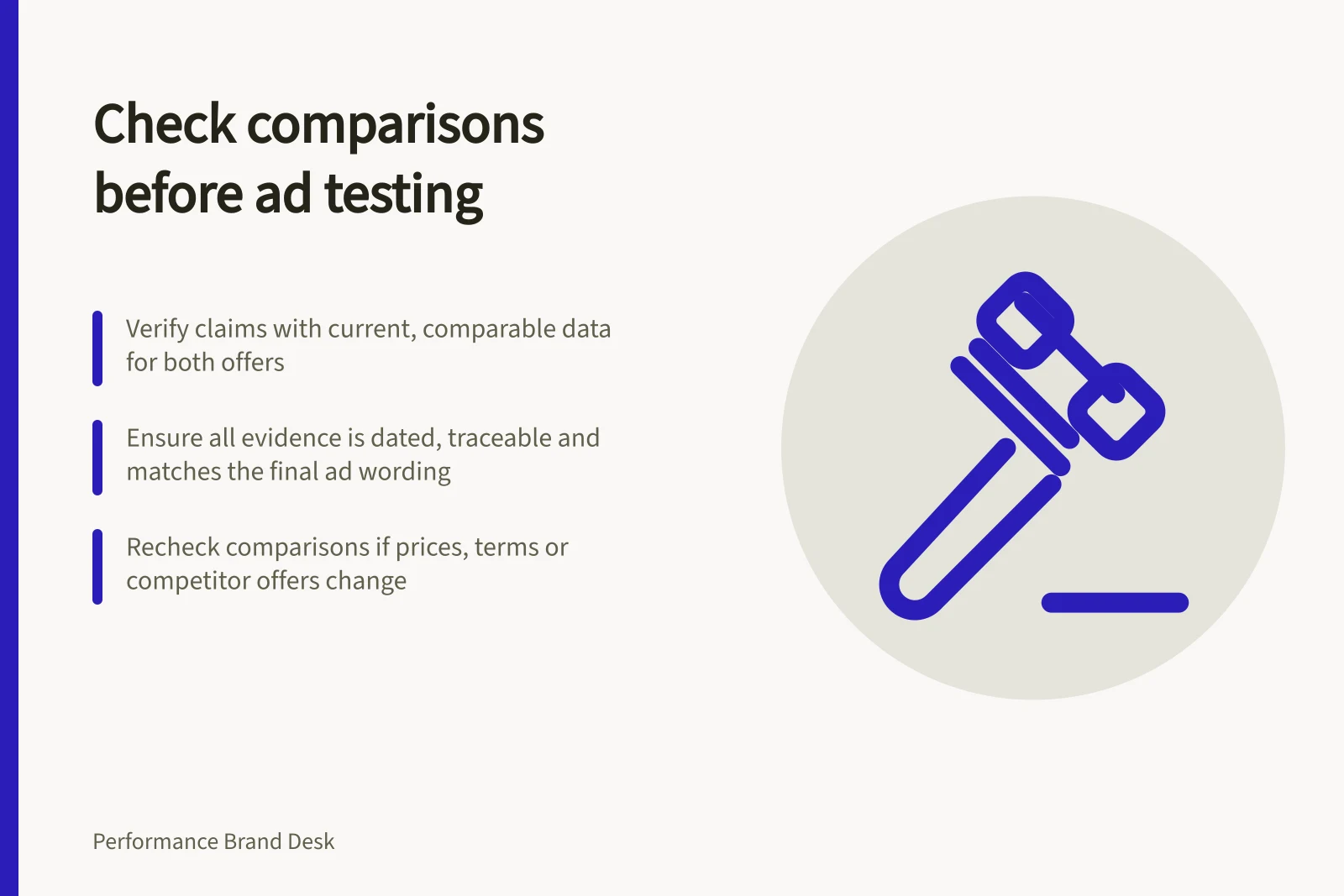
Verify any comparison before testing an ad that compares your offer with another. A split test may show how two finished ads perform, but it cannot make an inaccurate or unfair claim acceptable. Before either variant runs, approve the exact comparison, its supporting record and the version customers will see.
Turn the headline into a checkable statement
Write down what “faster”, “more”, “cheaper” or “better” refers to. Identify the products or services, configuration, location, period and measure. “Lower delivery cost” could mean a listed fee, the total payable amount or the cost for one address; each needs a different check.
The ACCC says it can require businesses to back up claims about their products or services. The overall message matters, including images and qualifications. Fine print cannot repair a headline that suggests a broader advantage than the evidence supports.
Key Regulatory Guidelines for Australian Advertisers
- ACCC Power to Require Evidence
- Businesses must back up claims about products or services
- Overall Message Matters
- Images and qualifications affect perception of claims
- Fine Print Cannot Fix Misleading Headlines
- Qualifications cannot override a false impression
Inspect the basis
| Record | What to confirm |
|---|---|
| Your offer | Current version, inclusions, terms and availability |
| Alternative | The specific competing offer under relevant comparable conditions |
| Measure | Definition, method and units |
| Evidence | Original records, capture date and person who can explain them |
| Wording | The claim and any material limit visible in the final ad |
| Recheck trigger | A price, specification, competitor or offer change that could invalidate it |
For a fictional equipment-hire ad, comparing two day rates would be incomplete if one includes a necessary charge and the other excludes it. Before claiming a saving, the team would need current, comparable total terms. This example reports no real provider prices.
If the evidence supports only a narrow comparison, state that point plainly. If the alternative cannot be verified on comparable terms, remove the comparison and describe your own offer without implying an unverified advantage. An old screenshot does not establish a competitor’s current price or service.
Common Pitfalls in Comparative Advertising
- Incomplete comparison
- One day rate includes mandatory fees; the other does not
- Outdated evidence
- Using an old screenshot to claim a competitor’s current price
- Misleading headline
- Suggesting broader advantage than supported by fine print
Approve the variants and recheck changes
Inspect every variant’s headline, visual, destination and mobile crop. The control ad needs the same claim review as the challenger. Record who approved each exact asset and when the comparison must be refreshed. If its basis changes during the test, pause or revise the affected claim and note the interruption in the test record.
After launch, performance data may help decide which approved execution to keep. It cannot establish that viewers understood the comparison, that the competitor’s offer stayed constant or that the claim was fair. Those questions need their own evidence.