Creative Testing
Part of Creative briefing and feedback
Giving feedback tied to the intended audience response
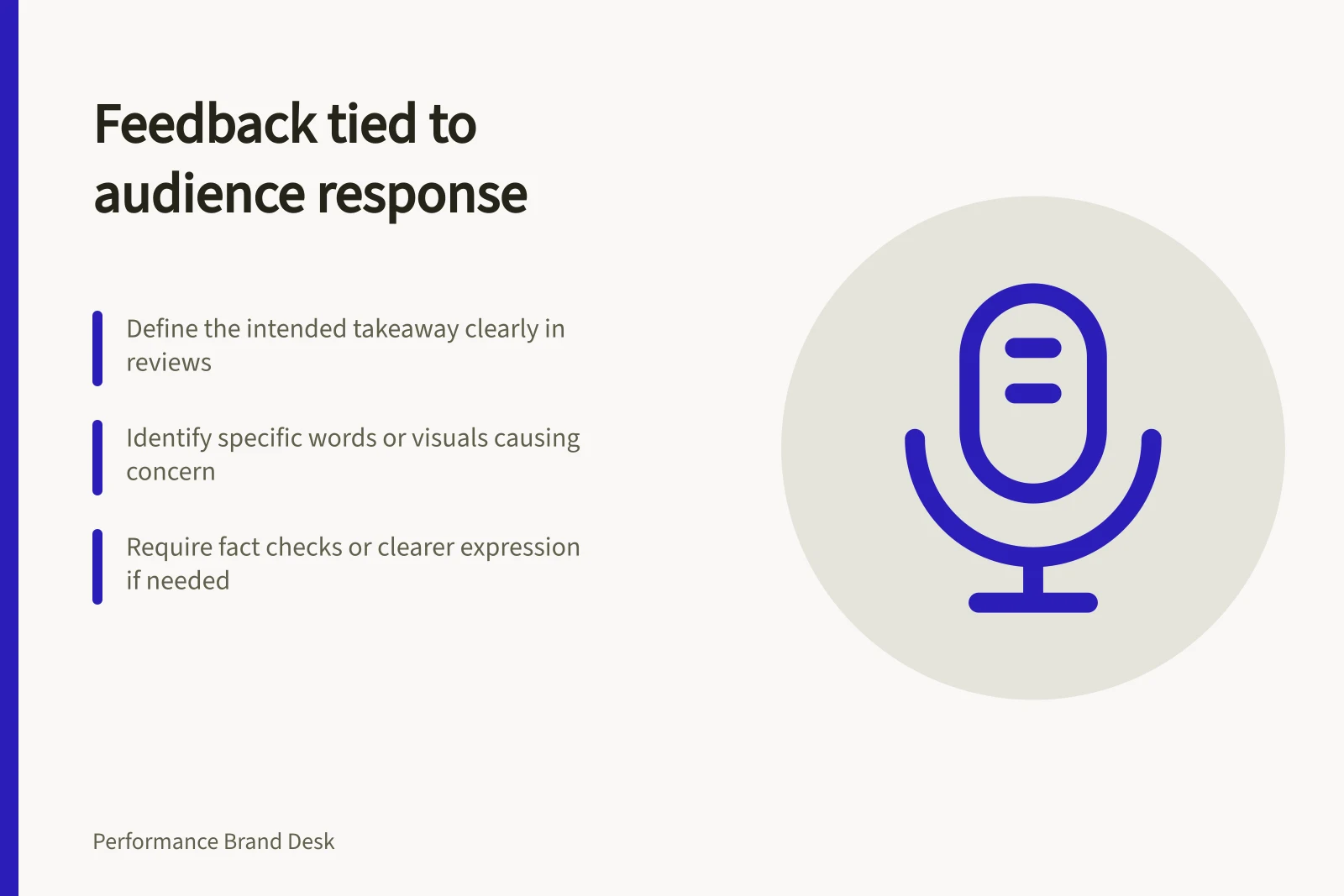
Write actionable creative comments by comparing the brief’s intended takeaway with the possible impression of the finished ad.
Compare the audience response the brief seeks with what the current execution may cause. Name the intended takeaway, point to the word or visual that raises concern, and explain the possible consequence. That gives the team a problem to solve, not a prescribed design answer.
Bring the intended response into the review
Put the brief’s takeaway and next step where reviewers can see them. For example: “A person should understand that the product’s dimensions are listed and know where to inspect them.” This describes the job assigned to the ad, not a finding about what viewers already understand.
Read the complete execution at the size and in the setting where it may appear. Include the headline, image, visible conditions and call to action. An accurate line can still sit beside an image that implies a broader result. The ACCC accepts reports about possible misleading or false claims, can require businesses to back up claims they make about their products or services, and may investigate and take compliance or enforcement action.
Feedback Best Practices by Source
- ACCC Guidelines on ClaimsBusinesses must substantiate claims; false or misleading claims can lead to enforcement action.
- NSW Education Feedback StrategyFeedback should focus on student understanding, not just correction.
- Ausmed: Effective FeedbackUse specific, constructive language focused on outcomes, not preferences.
- Columbia University: Audience ConnectionWriting is connection—feedback must reflect how the audience interprets the message.
Make the comment actionable
A concise comment can cover four points:
Point / Question
- Intended response
- What should the person understand or do?
- Feature
- Which word, image, order or omission raises concern?
- Possible response
- What might the person understand instead?
- Decision
- Is a fact check, claim decision or clearer expression needed?
“Make the headline more exciting” gives no reason to change it. “The headline says the item fits small spaces, but no dimensions are visible; a viewer may assume it fits their own space” identifies a possible overreach. The team can consider verified dimensions, narrower wording or a different message.
A reviewer’s prediction is not an audience finding. Write “may understand” unless the interpretation has been checked. A factual error can be corrected directly. When meaning remains disputed, refer that question for a separate comprehension check rather than presenting one reviewer’s view as proof.
Intended Audience Response vs. Possible Misinterpretation
- Intended ResponseA person should understand that the product’s dimensions are listed and know where to inspect them.
- Possible MisinterpretationA viewer may assume the product fits their space without seeing verified dimensions.
Steps for Giving Actionable Creative Feedback
- State the intended takeawayDefine what the audience should understand or do.
- Identify the feature causing concernPinpoint the word, image, order or omission that raises doubt.
- Predict possible responseExplain what the audience might understand instead (use 'may understand').
- Recommend next stepDecide if a fact check, claim decision or clearer expression is needed.
Key Elements of Actionable Feedback
- ✓ Intended response clearly statede.g., 'The viewer should know where to find dimensions.'
- ✓ Feature causing concern identifiede.g., 'No visible dimensions in the image.'
- ✓ Possible misinterpretation explainede.g., 'Viewer may assume it fits any small space.'
- ✓ Decision path suggestede.g., 'Verify dimensions or rephrase headline.'
Separate different kinds of comments
A wrong specification needs correction. An unsupported implied benefit needs a claim decision.
A missed takeaway may need a clearer hierarchy. A call to action that leads somewhere unexpected needs the destination checked. A colour preference should be labelled as a preference and weighed against the communication job.
Also say what the revision should preserve. If the central meaning is clear but one condition is obscured, ask for a local correction and review the resulting ad again. Read the revised words, visuals and destination together. The outcome of feedback is a reasoned decision about this execution, not a longer list of comments.