Creative Concepts
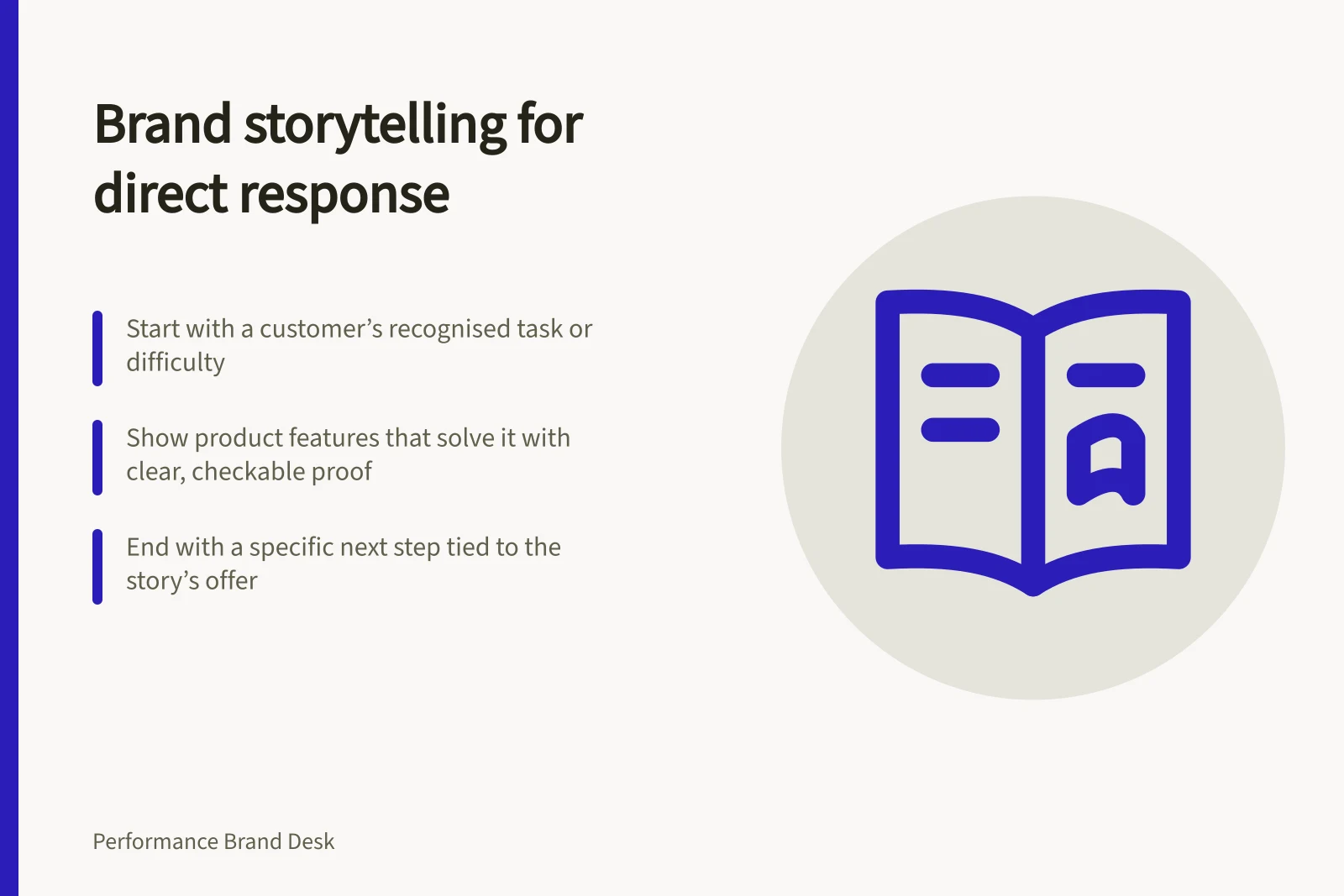
Brand storytelling for direct response
Structure a direct response brand story around a customer situation, credible product value and a clear next step.
A direct response brand story should help someone recognise a relevant situation, understand what the product offers and know what to do next. Each part of the story should help that decision.
Build around the customer's decision
Start with the task or difficulty the customer may recognise. Show the product detail that addresses it, give a reason to believe the explanation, then offer a useful next step. This sequence can guide an ad, video or landing page, with the detail adjusted to the format.
For example, a fictional desk-lamp ad could show someone adjusting light over a work surface, then show an adjustable lamp head in use. “View the dimensions and controls” would give an interested viewer something concrete to check.
Introduce the product early enough that the audience can connect the situation to the offer. If a feature needs explanation, demonstrate it. If the offer is simple, move to the decision sooner.
Organise the story around one message
Before choosing details, identify the brand message the story needs to convey and the audience it is for. A brand story communicates a brand’s message and values through a narrative, rather than relying only on facts and features.
That gives the story a useful hierarchy: the audience’s situation provides context, the brand’s values explain why the subject matters to the business, and product information makes the offer understandable. Keep the message consistent as the story moves between those parts; extra background that does not support the message can distract from the decision.
Give the brand a useful role
Make clear which brand and product the story concerns. A founder belongs in the story when a documented decision helps explain a feature or service. A customer account can help explain an experience when it is genuine and accurately presented; one person's experience does not establish a result for everyone.
Choose a central product promise and show how the product delivers it, keeping the brand's role visible.
Connect brand meaning to product information
A narrative can give product information a human context without replacing it. Storytelling can show the human side of a business and draw parallels between consumers’ values and a brand’s identity.
In a response-focused story, place product information where the audience needs it. When the narrative moves from the customer’s situation to the product, name the feature or process that addresses it; when it moves from brand values to the offer, show how those values shape a concrete product choice. This makes the connection explicit without turning the story into a specification sheet.
Make the proof checkable
A product explanation should be built around statements the business can substantiate. The ACCC says it can require businesses to back up claims about their products or services, and may investigate a business that misleads people.
Match each claim in the story to the evidence that supports it before writing the final wording. Keep the claim connected to the relevant specification, demonstration or process, and ensure that the explanation does not imply more than the business can support.
ACCC Guidelines on Advertised Claims
- Requirement for substantiation
- Businesses must back up claims about products or services.
- Investigation authority
- ACCC can investigate misleading advertising.
- Review manipulation risk
- Fake or manipulated online reviews are reportable under ACCC rules.
Separate personal experience from general claims
A genuine customer account can explain one person’s experience, but it should not be presented as proof that every customer will have the same result. When reviews appear in the story or destination, the ACCC accepts reports about fake or misleading reviews and review manipulation.
The ACCC does not resolve individual disputes about online reviews or provide legal advice.
Make the action follow the story
Ask for the information or transaction the story has prepared someone to seek. After a demonstration, “See how it works” may be more useful than “Learn more”. A purchase action makes more sense when the customer can see the information needed to decide.
The destination should carry through the offer presented in the story and make material conditions clear.
Use a real campaign as an architecture example
Tourism Australia and SPH Media’s “Take Me Back to Australia” campaign used traveller memories as its starting point, then curated submissions into multi-frame carousels. The carousels paired personal experiences with regional highlights and insider tips, so the story also functioned as a travel guide.
The campaign’s two phases kept the source material and its later presentation distinct; a brand adapting this approach would still need to make clear which parts are individual experiences and which are product information.
Campaign Architecture: 'Take Me Back to Australia'
- Phase 1: Collect authentic storiesTourism Australia gathered personal travel memories from diaspora Australians.
- Phase 2: Curate into multi-frame carouselsStories paired with regional highlights and insider tips for travel planning.
- Phase 3: Maintain transparencyClearly distinguish individual experiences from official product information.
Review the journey
Read the ad and destination together. Can a reader identify the situation, the product's role and what the click will provide? Check the actual format and mobile view before launch.
Check the whole narrative
Check that the story remains coherent when a viewer encounters its parts out of order, as can happen in a multi-frame or social format.
In this guide
- Opening with a customer problem rather than company historyWrite a customer-problem opening that leads quickly to a real product detail without overstating the customer's experience.
- Using a founder story only when it explains product valueDecide whether a founder story explains a real product choice, and check the claims it may imply before using it in an ad.
- Connecting a brand narrative to a concrete next stepChoose a call to action that follows the story, then check that the destination delivers the information or task it promises.
- Removing emotional claims unsupported by the product experienceAudit emotional advertising claims against product features, real limits and the customer experience, then keep, qualify or cut them.