Creative Testing
Part of Creative consistency across touchpoints
Identifying contradictions between ads and customer reviews
Compare ad promises with relevant customer reviews, verify the product and period, and decide when to correct, clarify or investigate a claim.
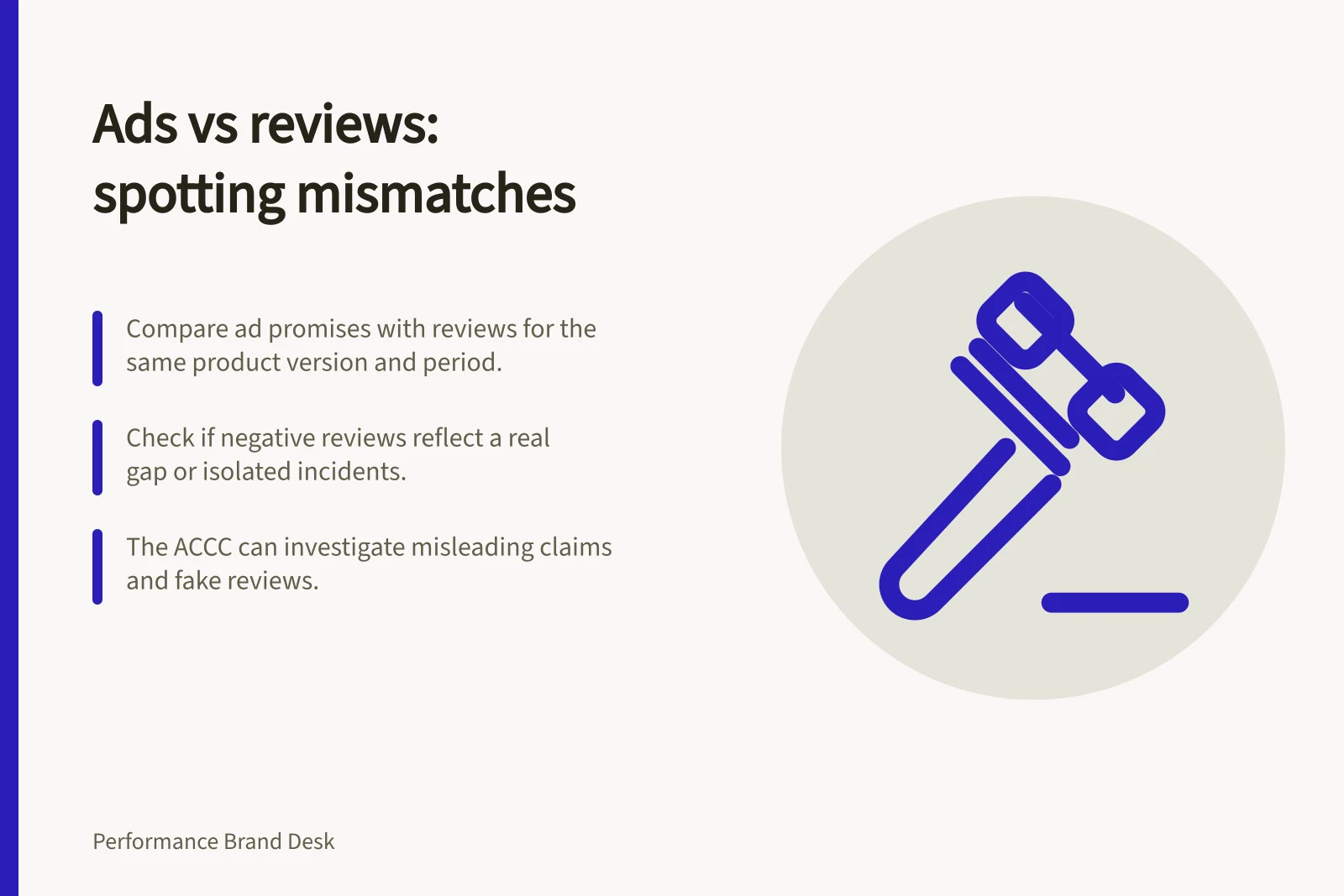
To investigate an apparent contradiction, compare a specific ad promise with reviews about the same product version, service and period. A negative review is a reason to check the claim, not proof that the ad is false. One detailed account can warrant action; similar accounts can raise its priority. Neither establishes how often the experience occurs among all customers.
Put the promise and experience side by side
Write the ad’s likely takeaway as a statement that can be checked. Record its image, visible qualification and destination, because the full execution can imply more than its headline says. Then collect relevant reviews with their dates, product or service details and the aspect of the experience each describes.
Suppose an ad suggests that setup is included. A review saying the customer had to arrange setup separately raises a direct question about the package and period advertised. A review about a different package or an earlier policy needs separate treatment.
| Record | Question |
|---|---|
| Ad promise | What would a reasonable viewer expect? |
| Review account | Which experience is described, and for which version and date? |
| Business record | What do current terms, fulfilment and support records show? |
| Decision | Should the claim be kept, clarified, corrected or paused while investigating? |
Keep the reviewer’s original wording in the investigation record. Do not turn several comments into a quotation or a population-wide rate.
Check relevance and credibility
A review may concern another seller, an old product version, an individual service failure or a circumstance clearly excluded from the offer. It may also reveal a real gap between the ad and what customers receive. Seek enough detail to investigate, then compare the account with current product information and operational records. Lack of detail calls for caution, not automatic dismissal.
The ACCC accepts reports about fake or misleading online reviews and review manipulation, and says it can investigate if a business misleads people in relation to online reviews. Do not remove a review merely because it conflicts with an ad. If authenticity is in doubt, establish an adequate basis before seeking removal or correction through the relevant platform’s process.
ACCC Guidance on Ad Claims and Online Reviews
- ACCC Accepts Reports on Misleading Reviews
- Yes – including fake or manipulated reviews
- ACCC Can Require Claim Support
- Yes – businesses must back up claims about products/services
- Review Removal Policy
- Do not remove just because it contradicts an ad; verify authenticity first
Decide what to change
If the promise is inaccurate for the current offer, correct or pause the ad and align its destination. If the business intends to deliver the promise but sometimes fails, investigate fulfilment and support while assessing whether the ad’s overall impression remains supportable. If reviews concern a past version, make the current version and effective date clear where confusion is likely. If evidence is inconclusive, record that uncertainty.
The ACCC accepts reports about possible misleading or false claims, and can require businesses to back up claims they make about their products or services. Review what customers actually see while checking the underlying experience.
Close with a dated record of the ad version, review set, product or service version, records consulted, decision and owner. Revisit the claim if new evidence or a product change alters the assessment.
Steps to Investigate Contradictions Between Ads and Reviews
- 1. Identify the ad’s core promise and its context (image, qualification, destination)
- 2. Gather relevant customer reviews with dates, product/service details, and specific experience points
- 3. Check relevanceconfirm the review refers to the same product version, service, and time period as advertised
- 4. Assess credibilitylook for detail; avoid dismissing vague or negative reviews without investigation
- 5. Cross-reference with current business records (terms, fulfilment logs, support data)
- 6. Decidecorrect, clarify, pause, or keep the ad based on evidence
- 7. Document decision with date, ad version, review set, and responsible owner