Creative Concepts
Part of Creative concept development
Choosing proof for a performance-oriented brand story
Match a brand story’s claim to suitable proof, keep its limits clear and give viewers a way to inspect the supporting detail.
Start with what a viewer is likely to believe, then choose evidence that supports that claim within its limits. A demonstration, specification, service term and customer account answer different questions. The strongest-looking asset may be the wrong support.
Identify the claim the story makes
Write the intended takeaway in one sentence. Then consider a stronger interpretation the words or images could create. A story about viewing appointment availability, for example, could imply that an appointment is secured immediately. Those claims need different support.
Record which product or service version the evidence covers, where it applies and whether it is still current. If it covers only certain locations or configurations, make that limit clear in the story. The ACCC can require businesses to back up claims they make about their products or services.
ACCC Guidelines on Advertising Claims
- Businesses must back up claims
- Under ACCC regulations, claims about products or services require substantiation.
- Fake reviews are prohibited
- The ACCC accepts reports of manipulated or fake online reviews.
- Permission required for quotes
- Any customer quotation used in advertising must be accurate and authorised.
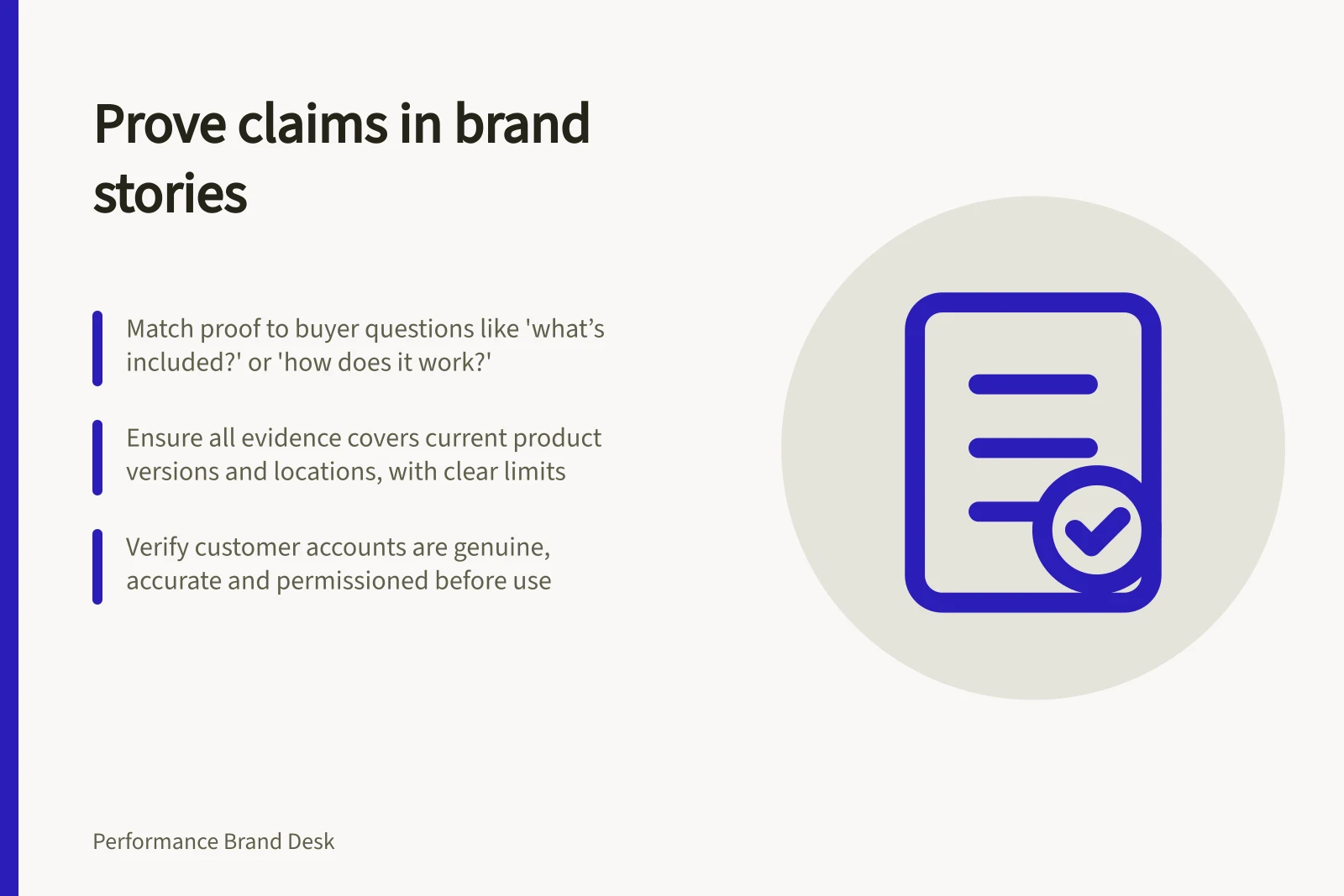
Match the proof to the buyer’s question
| Buyer’s question | Proof that may help | Limit to keep clear |
|---|---|---|
| What is included? | Current contents list or service scope | Inclusions may differ by version or location. |
| How does it work? | Faithful demonstration or process walkthrough | It shows the conditions depicted, not every outcome. |
| Will it meet my requirements? | Relevant dimensions, compatibility details or eligibility rules | The buyer may need to compare their own circumstances. |
| What was another person’s experience? | Genuine, accurately presented customer account | One account does not establish a typical result. |
Use this as a selection aid, not a ranking of which proof format performs best. Check the record behind any chosen proof. A polished demonstration is weak support if it conceals a necessary setup step or shows a configuration customers cannot obtain.
Show the proof where it answers the question
Take a fictional equipment-servicing business that proposes to give customers an itemised report after each visit. Its story could show the report format while explaining what the service includes. A blank example would show the report’s structure; it would not prove that every possible fault will be found. Before using the story, the business would need to confirm its current service scope, report process and destination.
Ask what each badge, number, image or account actually establishes. If it answers no question in the story, remove it. If the evidence supports only a narrower claim, narrow the story rather than surround a broad promise with qualifications.
Handle customer accounts within their limits
A customer account can convey that person’s experience when it is genuine and accurately presented. It cannot, on its own, establish what everyone will experience. The ACCC accepts reports about fake or misleading online reviews and review manipulation. Any quotation selected for an ad also needs an accuracy and permission check before use.
Using Customer Accounts in Brand Stories
- Pros
- Conveys real user experience when genuine and accurately presented.
- Cons
- One account cannot represent typical results or guarantee outcomes for all users.
Give the audience a way to inspect the proof
Choose a next step that lets the viewer examine the relevant detail: view specifications, inspect service scope or check eligibility. Read the finished ad and destination together. If the ad’s evidence concerns one version but the destination shows another, correct the mismatch before using the story.