Creative Concepts
Part of Brand storytelling for direct response
Using a founder story only when it explains product value
Decide whether a founder story explains a real product choice, and check the claims it may imply before using it in an ad.
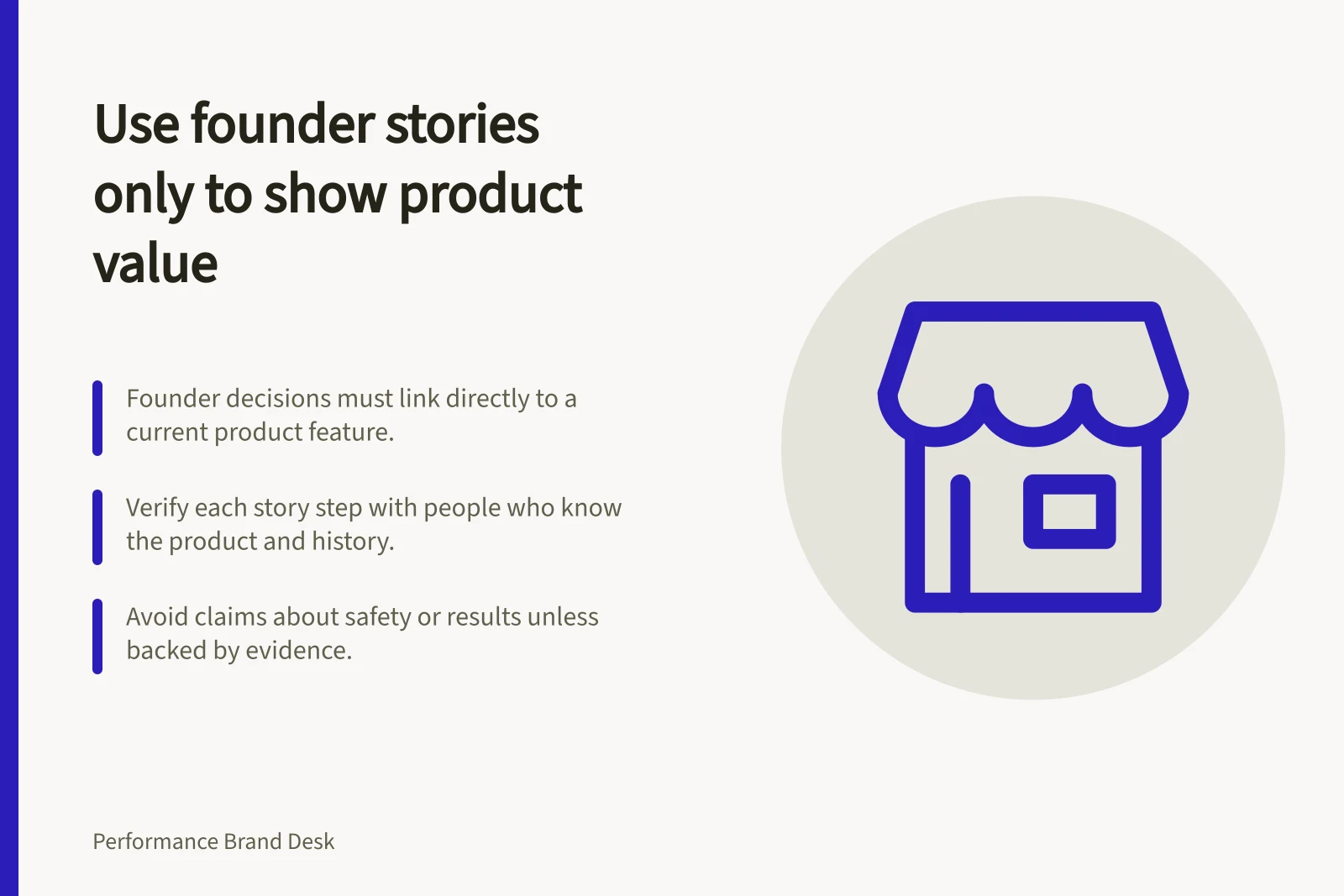
Use a founder story in response creative when a documented founder decision helps customers understand a product feature or service choice. The audience should be able to connect the story's event to something they can examine in the current offer.
Test the connection
Complete this sentence: “The founder encountered this problem, the business made this product decision, and customers can now check this consequence.” Verify each link with people who know the product and its history. If the consequence is only that the founder cares, the account adds personality without explaining product value.
Imagine a fictional lamp maker whose founder found a fixed shade awkward to aim over a narrow work surface. A relevant account would connect that observation to an adjustable head, show the current lamp in use and give its dimensions. The story would not establish that the lamp prevents eye strain or improves productivity.
How to test if a founder story adds product value
- Identify the founder’s original probleme.g., fixed lamp shade was hard to aim over narrow work surface
- Link it to a documented product decisione.g., design of adjustable head
- Show how customers can now check the outcomee.g., dimensions, real-world use, product specs
- Verify with product team or history recordsEnsure alignment between past event and current product
- Remove or revise if only emotional appeal remainsAvoid stories that only show founder care without product proof
Keep the account in proportion
Start with the customer need, introduce the founder's decision briefly and show the product while telling the story. A long biography can delay the answer a response ad needs to give.
Leave the founder out when a demonstration explains the offer more clearly. Personal experience also cannot, by itself, support claims about safety, durability or typical results.
If several people developed a feature, credit them accurately. The ACCC says claims about a product's qualities, performance and history should be truthful and supportable; its guidance does not verify any founder's personal account.
Key facts from ACCC guidelines on advertising claims
- Truthfulness requirement
- All claims must be truthful and supportable
- No verification of personal accounts
- ACCC does not validate founder stories, only product claims
- Support for safety and durability claims
- Must be backed by evidence, not personal experience
- Disclosure of multiple contributors
- If several people developed a feature, credit them accurately
Check what the story implies
A line such as “I made this so no one would struggle again” suggests a broad result. “We designed an adjustable head after finding fixed light difficult to position in our workshop” describes a narrower decision, if the account is documented. Confirm that the product sold today has the feature shown.
Before using the story, check the event, the claimed design link and the current product, and consider what a reader might infer beyond the words used. Revise or omit any part the business cannot support.
Pros and cons of using a founder story in ads
- Pro: Builds authenticity and relatabilityCustomers connect with real human experiences behind a product
- Con: Can imply unsupported claims if not verifiedStatements like 'I made this so no one would struggle again' may suggest broader benefits than proven
- Pro: Explains product decisions clearly when linked to featuresHelps customers understand why a product works a certain way
- Con: Lengthy biographies delay the key messageAudiences want quick answers—personal history should not overshadow product value
- Pro: Enhances brand trust when truthful and consistentTransparency about origins strengthens credibility