
Creative Briefing
Part of Creative concept development
Separating a creative concept from a visual variation
Decide whether an ad changes the underlying idea or its presentation, and record the difference before production or testing.
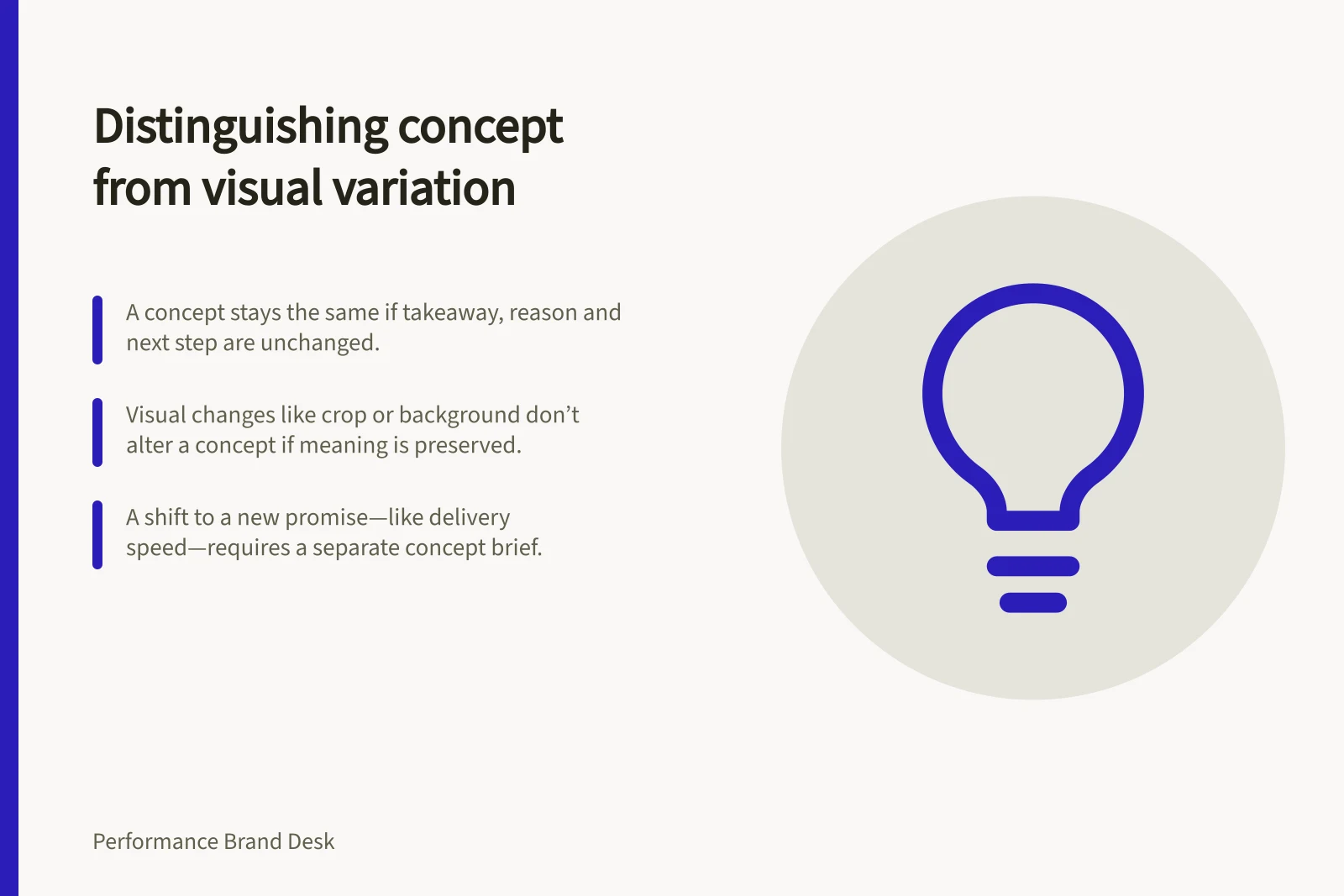
A creative concept determines the idea an ad asks someone to understand. A visual variation changes its presentation. Compare the intended takeaway, supporting reason and next step: if they stay materially the same, the new asset is usually a variation. If one changes materially, give the work a separate concept brief.
State the idea without naming a format
Write a concept sentence that could guide a still image, video or text ad. For a fictional desk lamp: “Show buyers how to check whether its adjustable head can direct light over their work surface.” A close-up and a diagram could express that idea differently. The movement of a real lamp would need verification before either asset ran.
An ad about available finishes answers a different buying question. An ad claiming improved concentration makes a stronger, different promise requiring its own support. Calling all three “lamp creative” hides those differences.
| Proposed change | Working classification | Check |
|---|---|---|
| Crop or background changes; the same feature and action remain clear | Visual variation | Does the delivered image preserve the meaning? |
| A demonstration replaces a diagram for the same promise | Execution or proof variation | Does it imply a broader capability? |
| The message shifts from adjustability to delivery speed | New concept | Is the new promise supported? |
| The action shifts from viewing specifications to buying | Possible concept change | Has the audience been given enough information for that decision? |
These labels help organise production; the audience’s likely interpretation decides whether the meaning has actually stayed the same.
Check what the image adds
A photograph of the lamp lighting a large room could imply more than a close-up of its movable head. Images and descriptions can shape the impression an ad creates. Review the headline, image and any qualification together before treating two assets as equivalent.
Ask what each version appears to offer without relying on its filename or production brief. If one implies room-wide lighting and the other only shows adjustability, record the difference in the concept statement and review the stronger claim.
Guidelines for Ad Claims in Australia
- ACCC Rule on Misleading Claims
- Ads must not be false or misleading under the Australian Consumer Law
- Google Ads Policy
- Claims must be substantiated and clearly verifiable
- Australian Standard
- Visuals must align with stated claims—no implied benefits without proof
Record the change at the right level
Give each concept an audience question, intended takeaway, approved support and next step. Under that record, list its executions and their changes, such as crop, sequence, demonstration or wording. Several files can express one proposition.
This distinction also limits what a later comparison can establish. Two ads that change message, image and destination together compare finished packages; they do not isolate a concept’s effect. A detailed test design belongs in the campaign’s testing plan.
If a platform experiment is planned, confirm the available method for that campaign.


