Creative Concepts
Creative concept development
Develop ad concepts around a buyer decision, a supportable promise and a useful next step. Learn how to shortlist and prototype distinct ideas.
A creative concept is the central idea an ad communicates about a buyer’s decision. Develop it by choosing the question the ad answers, a supportable product or service promise, and the audience’s next step. Headlines, images and formats express that idea.
Start with the buyer’s decision
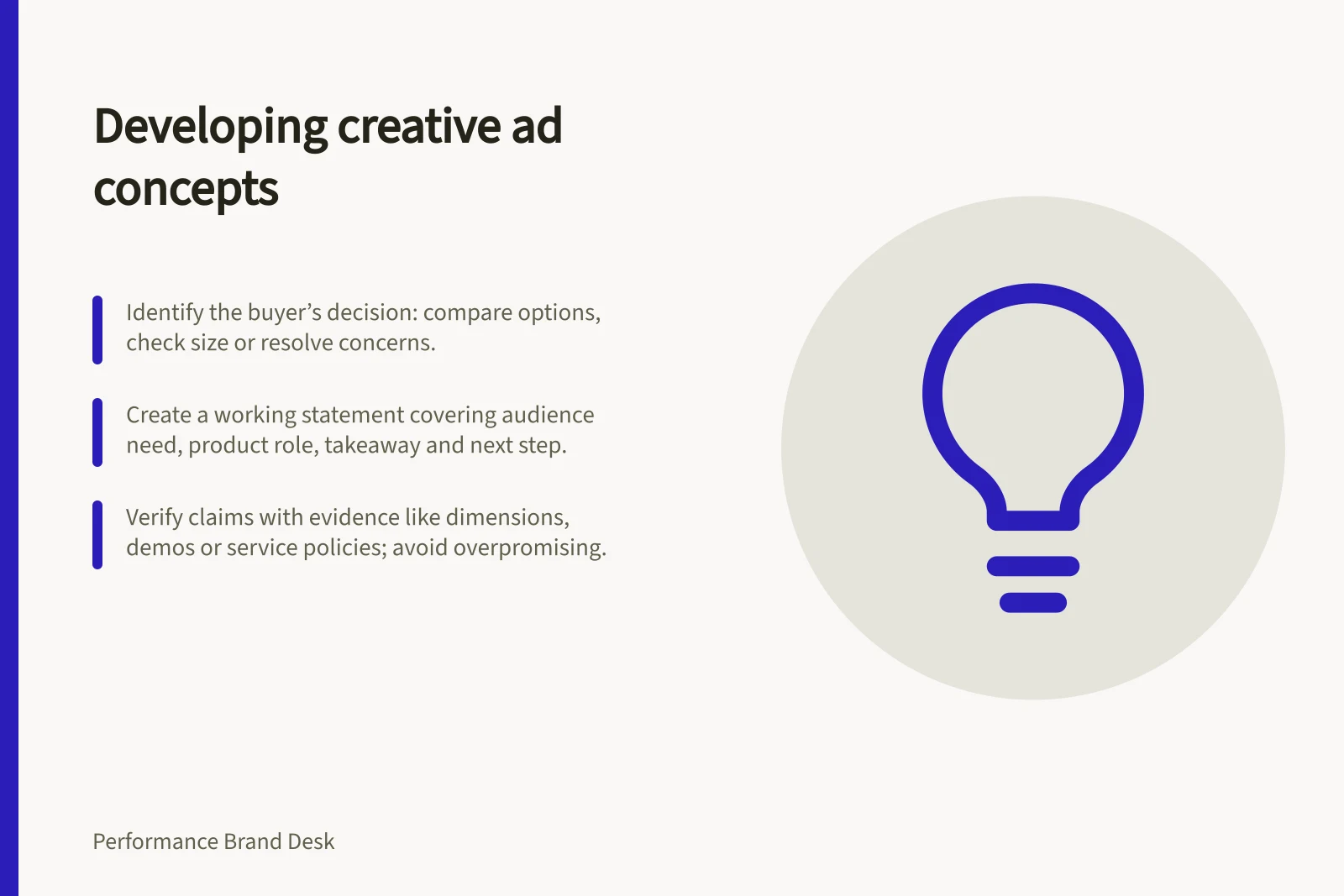
Ask whether the audience is trying to understand an unfamiliar offer, compare options or resolve a concern before buying. Choose one communication job for the concept. “Show how to check the product’s size” gives more direction than “make the brand feel simple”.
Gather customer questions, current product details, service terms and evidence for proposed claims. A repeated question is worth investigating, though repetition alone does not show how common it is among all buyers. Before centring an ad on the question, check the offer and destination can answer it.
Describe the idea before producing assets
Write a short working statement covering the audience’s decision, the product’s role, the intended takeaway, the evidence and the next step. It guides production; it is not finished ad copy.
For a fictional furniture retailer whose product page lists assembled dimensions, a concept could help shoppers compare a shelf’s measurements with their available space. A still image and a short sequence could express that idea in different ways; neither should suggest the shelf fits every room. Before use, the business would need to verify the dimensions for the product being sold and show them at the destination.
An idea about assembly or delivery answers a different question. Give each proposed concept its own statement, so the team can distinguish a change in meaning from a new presentation of the same idea.
Shortlist distinct directions
Develop a few directions that answer different buyer questions. For the fictional shelf, these might cover assembled size, included parts or delivery arrangements. Each direction needs its own current supporting information.
Review each direction for relevance to the buyer’s decision, clarity of the likely takeaway, support for its words and images, and a next step the destination can fulfil. This review helps decide what to develop; it does not predict campaign results. Drop or narrow an idea if its likely promise exceeds what the business can establish.
Pre-Production Validation Checklist for Creative Concepts
- Does the concept address a clear buyer decision?Yes
- Is the promised outcome supportable by evidence?Yes
- Can the destination fulfil the proposed next step?Yes
- Is the claim limited to what the evidence supports?Yes
- Have potential customers been consulted on key assumptions?Yes
- Is there a unique concept statement for each direction?Yes
Check directions with potential customers
When a direction rests on an assumption about what buyers understand or want, gather reactions from potential customers before committing to production. Surveys, interviews and informal conversations can ask for their views; use the feedback to refine the idea rather than treating one person’s response as representative of every buyer.
Keep a record of what you asked and what you heard. This gives the team something concrete to revisit when choosing between directions, while keeping customer feedback distinct from evidence that supports a product claim.
Put proof into the concept
Choose evidence that fits the claim. A specification can support a stated dimension for the relevant product version, while a demonstration can show a feature operating under the conditions depicted.
A service policy can explain an accurately described process. None automatically proves a broader result such as suitability for everyone.
The ACCC can require businesses to back up claims they make about their products or services. Keep the concept’s claims supportable and avoid wording that goes beyond the evidence.
Supporting Evidence for Claims: What Works Where
- Claim TypeDimension (e.g., shelf size)
- Best Supporting EvidenceProduct specification or measured data from the relevant product version
- Claim TypeFeature performance (e.g., how a function works)
- Best Supporting EvidenceDemonstration under real-world conditions shown in video or animation
- Claim TypeService policy (e.g., delivery timeframe)
- Best Supporting EvidenceClear explanation of the accurate process, terms and conditions
- Claim TypeBroad benefit (e.g., 'best for everyone')
- Best Supporting EvidenceNot automatically proven by any single piece of evidence – requires careful limitation and context
Key Regulatory & Industry Guidelines for Australian Ad Creatives
- ACCC Advertising RulesAll claims must be substantiated; false or misleading claims can lead to penalties.
- IAB Australia Digital Creative StandardsCreative must respect platform context and adapt to placement size and format.
- TDS Australia Production ProcessIncludes concept exploration, feedback refinement, and execution across channels.
- Business.gov.au Product Development AdviceNew products should be tested with customers before full launch.
- Rubiix Australia Launch SupportProvides guidance on launching new products and services in Australia.
Prototype the shortlisted ideas
For each concept, draft a headline, visual description, proof element and action. View the rough execution at its intended size. If the idea needs a long explanation in that placement, simplify it or choose another placement.
Keep the concept statement and its claim limits with the resulting assets. That record makes it easier to see whether a later version changed the idea, its proof or its presentation. Campaign results require a separate comparison plan.
Plan the production handoff
Once a direction is approved, translate it into an execution brief for the people making the assets. TDS Australia describes a process that moves from exploring initial design concepts and visual directions to refining them with feedback, then bringing the approved concept to life in design execution.
List the channels and formats the production needs to cover, such as social media, print, digital advertising or video. TDS Australia identifies campaign guidelines as a way to support consistent execution across channels; include the agreed visual and verbal direction so each asset expresses the same concept.
Review each rough execution in its intended context. IAB Australia’s digital creative guidance stresses respecting context and adapting creative to the platform, so check that the intended takeaway remains clear in each placement rather than assuming one execution will suit them all.
In this guide
- Building ad concepts from customer objectionsUse a customer concern to develop an ad concept: identify the real decision, verify the answer and check the promise the ad makes.
- Separating a creative concept from a visual variationDecide whether an ad changes the underlying idea or its presentation, and record the difference before production or testing.
- Choosing proof for a performance-oriented brand storyMatch a brand story’s claim to suitable proof, keep its limits clear and give viewers a way to inspect the supporting detail.