Creative Testing
Part of Brand safety in performance messaging
Reviewing customer quotations for permission and accuracy
Review the source, context, authority and final presentation of a customer quotation before using it in an Australian ad.
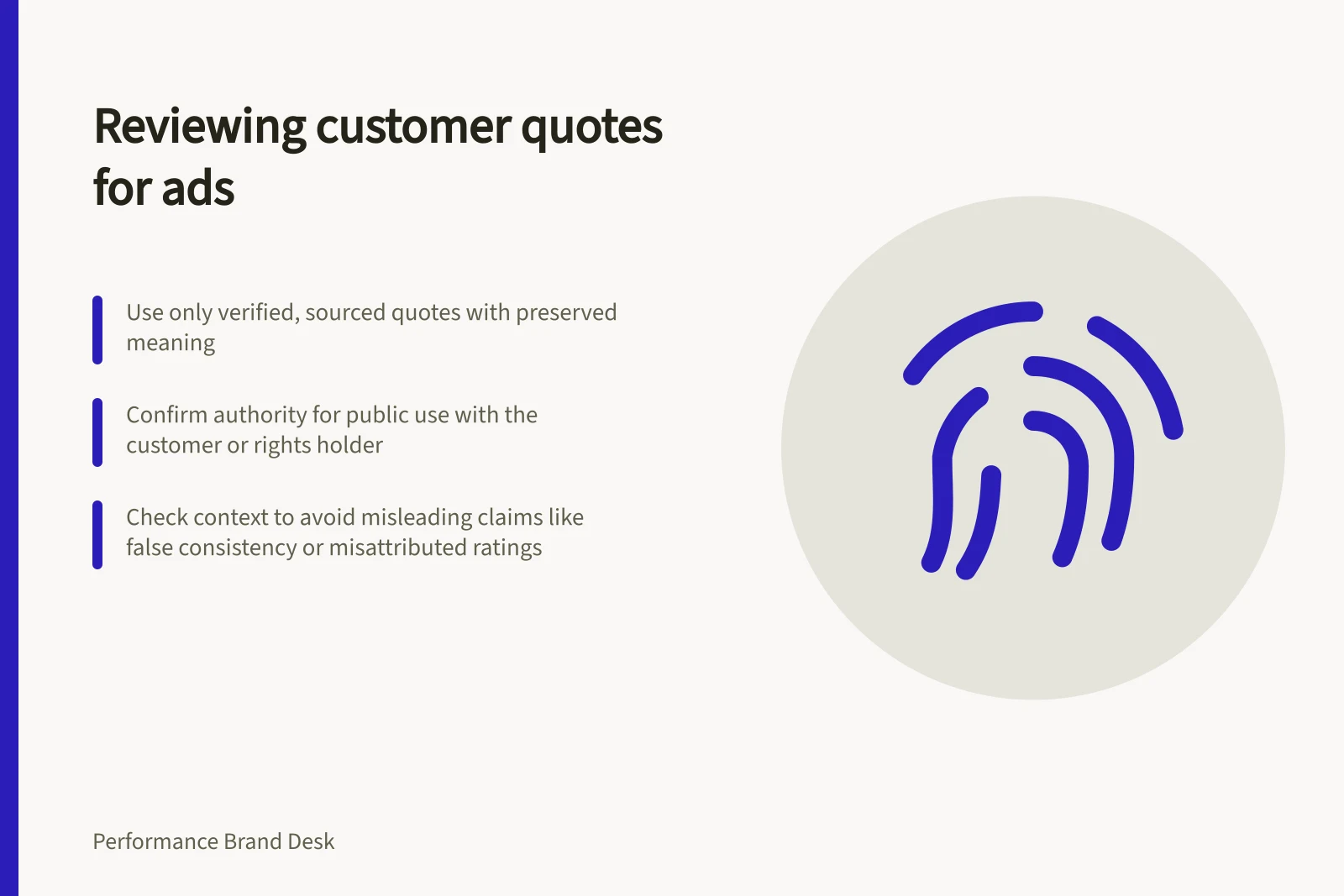
Use a customer quotation in an ad only when you can identify its source, preserve its meaning and establish authority for the proposed public use. Review the words together with the name, image, rating, product and design around them. Those details can imply a stronger endorsement than the original account supports.
Establish who said what
Locate the original review, interview recording or written message. Note when it was given, which product or service it concerned and whether the person used that offer. If the original is unavailable, do not reconstruct a quotation from a summary or several people's comments.
Compare the proposed line with its full context. Removing a qualification, changing tense or joining separate sentences can alter its meaning.
The ACCC accepts reports about fake or misleading online reviews and review manipulation. One customer's experience does not, by itself, establish a typical outcome.
Check authority for this use
Do not treat a public review as blanket approval to reproduce a person's words in a paid ad. As an approval practice, confirm the proposed wording, attribution, channels, territory and intended period with the customer or another holder of the relevant rights.
Check any name, portrait, voice or identifying detail separately. Keep the authority record with the approved asset and provide a way to request a change or withdrawal.
For organisations covered by Australian privacy law, an identifiable customer account may also raise personal-information questions. OAIC guidance says APP 6 generally limits use or disclosure of personal information to the purpose for which it was collected, unless an exception applies, including consent or reasonable expectation of a related use.
The applicable privacy rule depends on the entity, information and use. Refer uncertainty to the privacy owner rather than treating a general review-submission checkbox as approval for every advertisement.
Key regulatory guidance on customer quotes in Australian advertising
- ACCC stance on fake reviews
- Accepts reports of misleading or manipulated online reviews
- OAIC guidance on APP 6
- Use of personal information requires consent or reasonable expectation of related use
- Privacy law applicability
- Applies to organisations handling personal information under Australian privacy law
Review the ad’s new context
A quote about one service visit should not sit beside a claim that every visit produces the same result. A star rating should not appear to belong to that customer unless it does.
Suppose a fictional customer says one booking was easy to arrange but their preferred time was unavailable. Using only “easy to arrange” may omit a limitation relevant to the proposed message. Preserve the meaning or choose another line. No actual customer is quoted here.
Before release, compare the final crop and caption with the original account and authority record. If accuracy or authority remains uncertain, use clearly identified brand-written copy. Keep the exact approved version so a later edit receives its own review.