Creative Concepts
Part of Performance creative research
Using customer language without fabricating testimonials
Use customers' words as research while keeping original ad copy distinct from genuine quotations, reviews and testimonials.
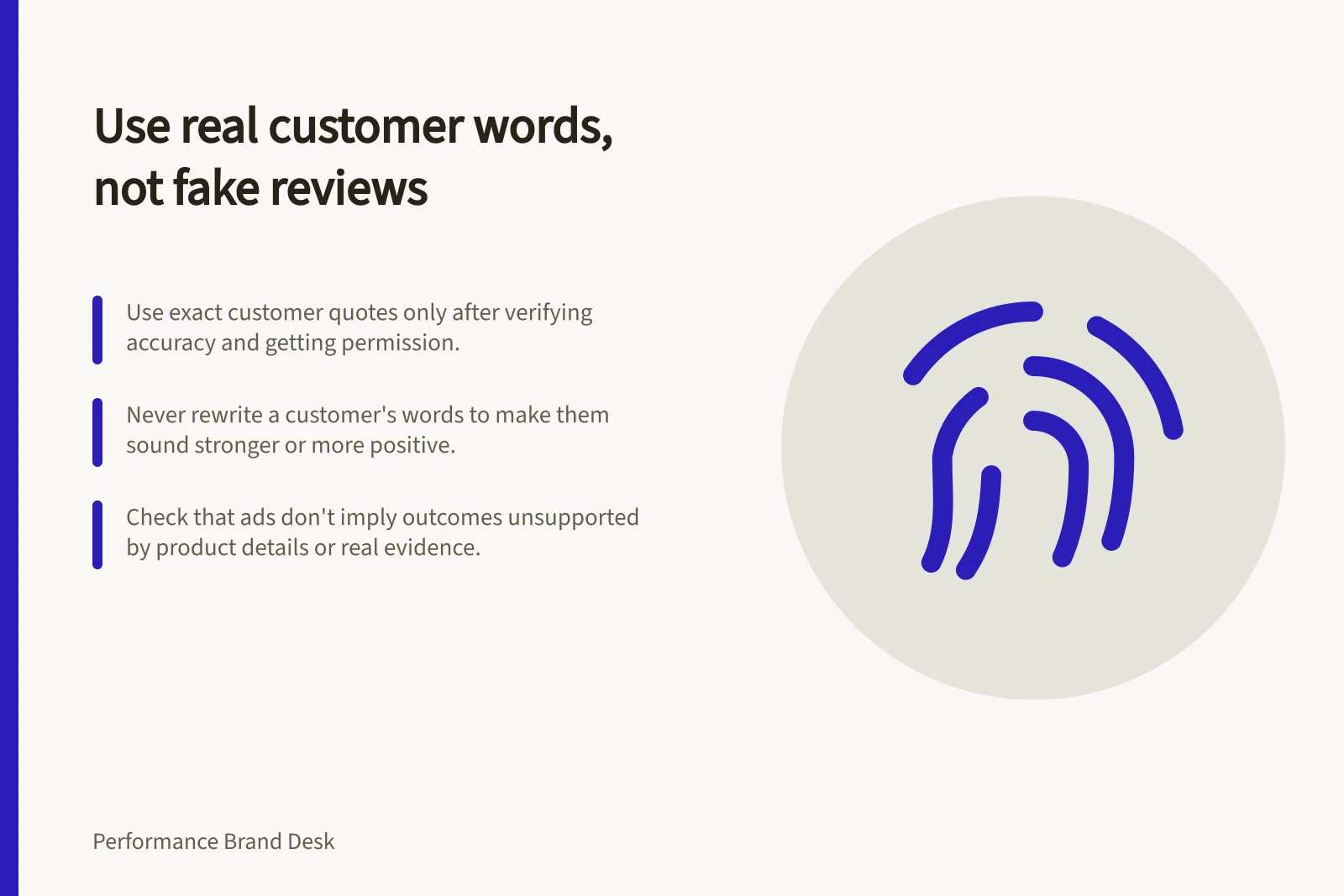
Use customer language to understand how people describe a task or concern. Write original copy that accurately describes the offer. If an ad presents words as a customer's experience, they must come from a genuine customer and retain their meaning. A sentence assembled by a writer is brand copy, not a testimonial.
Label the source of each line
| Language | Appropriate use | Boundary |
|---|---|---|
| Exact customer wording | A research clue, or a quotation after separate accuracy and permission checks | Do not edit it into a stronger claim. |
| A theme inferred from accounts | A prompt for an original explanation | Do not imply that one person said the new line. |
| Brand-written copy | A proposed message checked against the offer | Do not style it as an independent review or endorsement. |
Suppose enquiries to a fictional storage business concern package size. The team could write copy inviting buyers to inspect current package dimensions, if the destination provides them. It could not invent a satisfied buyer describing an easy delivery. This example contains no real customer statement or verified product claim.
Using Customer Language: Genuine vs. Brand-Written Copy
- Exact Customer WordingUse only after verification and permission; must not be edited to strengthen claims.
- Theme Inferred from AccountsUse as a prompt for original copy; do not imply it reflects one customer’s words.
- Brand-Written CopyMust reflect actual product details; never presented as an independent review.
Preserve the concern, not just an appealing phrase
Keep the original wording with its date, product and context. A person asking whether a package will pass through a doorway has raised an access question. They have not said delivery is easy, that the product always fits or that access was their main reason for choosing it.
Write a plain-language theme beside the original account and note exceptions. A small collection of comments can identify a question worth exploring; it cannot show how many buyers share it. If a customer's own words are considered for publication, refer the proposed quotation for a separate accuracy and permission review rather than treating the research note as publication-ready.
Check the impression of the ad
A star rating, portrait or first-person line can signal an independent customer account even when a marketer wrote it. The ACCC accepts reports about fake or misleading online reviews and review manipulation. It can investigate if a business misleads people in relation to online reviews.
Read the finished words and visuals together. Does the ad suggest an outcome the product information cannot support? Does the destination provide the detail people are invited to inspect?
Australian claims guidance calls for accurate, supportable information and an accurate overall impression. If a customer's phrasing suggests more than the business can establish, retain it as a research clue and write a narrower brand statement.
ACCC Guidance on Online Reviews and Testimonials
- Reporting fake reviews
- Accepted by ACCC
- Investigation threshold
- Misleading online reviews can trigger enforcement
- Compliance requirement
- Accurate overall impression in ads