Creative Concepts
Part of Performance creative research
Finding an overlooked buying concern in customer interviews
Use neutral customer interviews to locate a missed buying question, check its context and avoid overstating a small set of accounts.
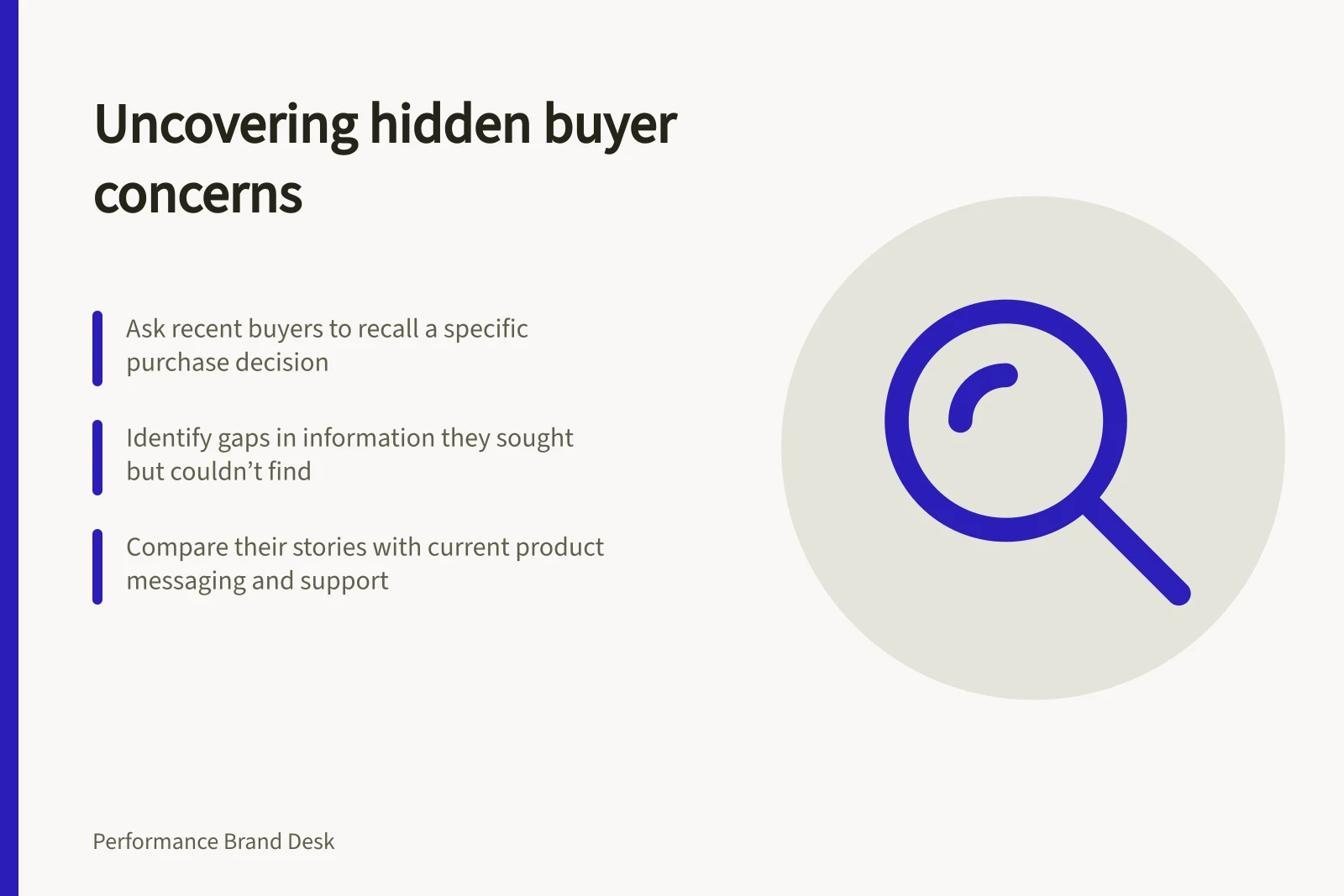
To surface an overlooked buying concern, ask people to reconstruct a recent choice, listen for information they sought but could not find, and compare their accounts with what your current messaging answers. Treat the concern as a candidate until other evidence shows whether it matters beyond those interviewed.
Ask about a specific decision
Talk to people close to the decision you want to understand: recent buyers, those who considered the offer and chose another route, or those still deciding. Record how they were recruited. Interviews only with enthusiastic customers may miss why others hesitated.
Open with an event: “Tell me about the last time you considered this kind of purchase.” Ask what prompted the search, which alternatives they weighed, what they checked and what they did next. Follow an unexpected answer with “What made that matter then?” instead of offering a list of possible worries.
Do not supply the answer in the question. “Was delivery access your main worry?” may steer the account. Avoiding wording that hints at the answer is a general caution, and applying it to interview prompts is an editorial judgement. Leave room for someone to say nothing was difficult.
Locate the question in the journey
“I wasn't sure about delivery” could mean timing, cost, package size, property access or what happens if nobody is home. Ask what the person looked for and what they did after finding or failing to find it. Do not merge different concerns because they share a word.
After each interview, record the situation, the concern raised before prompting, any described consequence for the decision, and the information that might have helped. Keep the person's wording alongside your interpretation. If you cannot tell whether the concern changed a decision, mark that uncertainty.
In a fictional garden-shed purchase, one person might ask about delivery access, prompting a check of the seller's delivery information. That would not establish that access is the leading concern for shed buyers, or that delivery is possible at every site.
Check whether the concern was overlooked
Compare the account with current ads, product pages, relevant enquiries and the service process. The information might already exist but be hard to find, or the concern might apply only in an unusual situation. Look for counterexamples and note where existing information resolved the question.
A few interviews can uncover a useful question but cannot estimate its prevalence. Decide what further evidence would change the next decision: more varied interviews, a review of relevant enquiries, or a closer check of the current page. Repeated comments drawn from one source are not independent confirmations.
If the question persists and the business has a dependable answer, pass it on with the buyer context and limits. If the answer is uncertain, resolve the information or service gap first. The finding should identify which buyer, at which decision, needed which answer.
Key findings from customer interviews on overlooked concerns
- Common missing info in product pages
- Delivery access requirements (e.g. gate width, driveway type)
- Most frequent concern raised
- Uncertainty about delivery feasibility at home address