Brand Positioning
Part of Creative consistency across touchpoints
Matching acquisition messages with the website experience
Audit the click from acquisition ad to website: check the product, promise, conditions and action a visitor actually encounters.
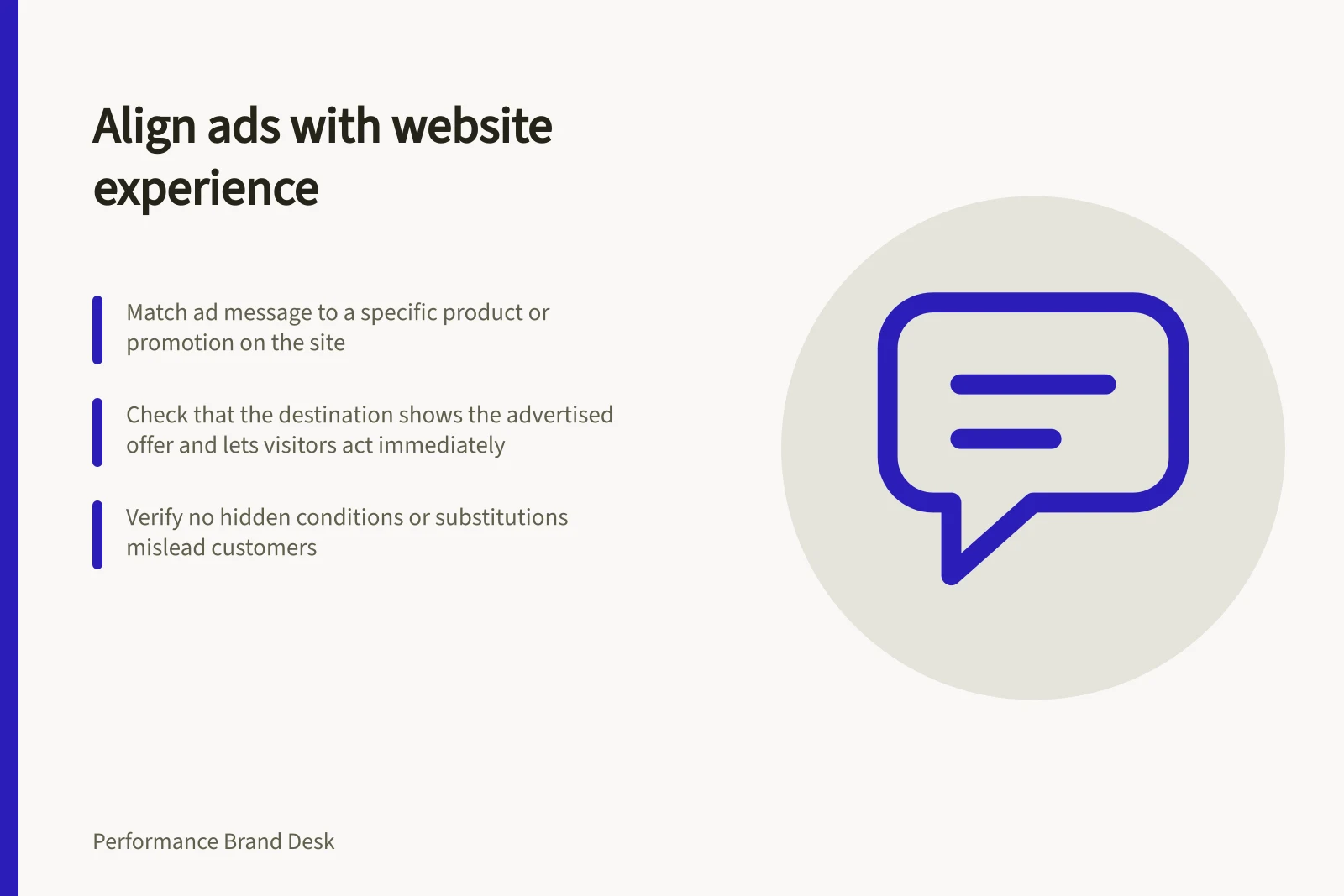
Match an acquisition message to the website by following the click a customer will make. The destination should show the advertised product or service, preserve the promise and let the visitor take the action offered. A broadly relevant homepage may still leave someone searching for the specific offer.
Trace one message to one destination
Write the ad’s likely takeaway in plain language. Include the product or variant, benefit, price or promotion if mentioned, material conditions and call to action.
Open the final destination as a new visitor on a phone. Check the first visible screen, the relevant detail further down and the action reached after tapping the button.
Compare the ad’s offer and call to action with what the destination shows and lets the visitor do. Check that the visitor can find the advertised product or promotion and complete the action the ad invites.
| Ad says or implies | Destination needs to provide |
|---|---|
| Inspect a particular product | That product and the relevant variant, or a clear route to it |
| Check a stated benefit | Detail that explains the benefit within its limits |
| Claim a promotion | The current offer and significant eligibility conditions |
| Book or enquire | A usable path to that action and enough information to decide |
The wording can differ. The visitor should still be able to recognise the offer.
Check consequential mismatches
Look for a different product version, an expired promotion, a service area condition disclosed only after a form, or a button that leads to a generic catalogue. Check the path after a location or size selection when that choice changes what the customer can obtain. If the advertised variant is unavailable, the page should not quietly substitute another while the ad continues to promise the first.
For a Shopping ad or free listing, compare the advertised product and variant with the landing page and check what happens to the price and availability at checkout. Note any differences between the ad, page and checkout.
Read the full impression
Compare the image, headline, visible conditions and destination together. The ACCC accepts reports about possible misleading or false claims and can require businesses to back up claims about their products or services. Check that the message a visitor gets from the ad is consistent with what the destination shows, including any conditions that affect the offer.
Before launch, record the ad version, final URL, relevant page state, device view and person responsible for the offer. Repeat the check after changes to price, availability, terms or page design. A click count shows interaction with an ad; it does not establish that the page loaded or supplied what the visitor expected.
Key regulatory and platform guidelines for ad-to-site alignment
- ACCC authority on misleading claimsAccepts reports and can require businesses to substantiate claims
- Google Ads policy on final URLsFinal URL must match the ad’s promise and lead to a relevant destination
- Google Merchant Center: Product availability at checkoutMust reflect actual stock and pricing; discrepancies may impact performance
- Google Merchant Center: Eligibility conditions for promotionsConditions must be clearly disclosed before checkout