Brand Positioning
Offer and message alignment
An offer is what the customer gets and on what terms. The message is the promise that draws attention to it. When these disagree, a sharper headline can bring more …
An offer is what the customer gets and on what terms. The message is the promise that draws attention to it. When the two disagree, a sharper headline can bring more clicks while making the buying decision harder. Check the journey from ad to landing page to checkout before changing either element.
Diagnose the mismatch
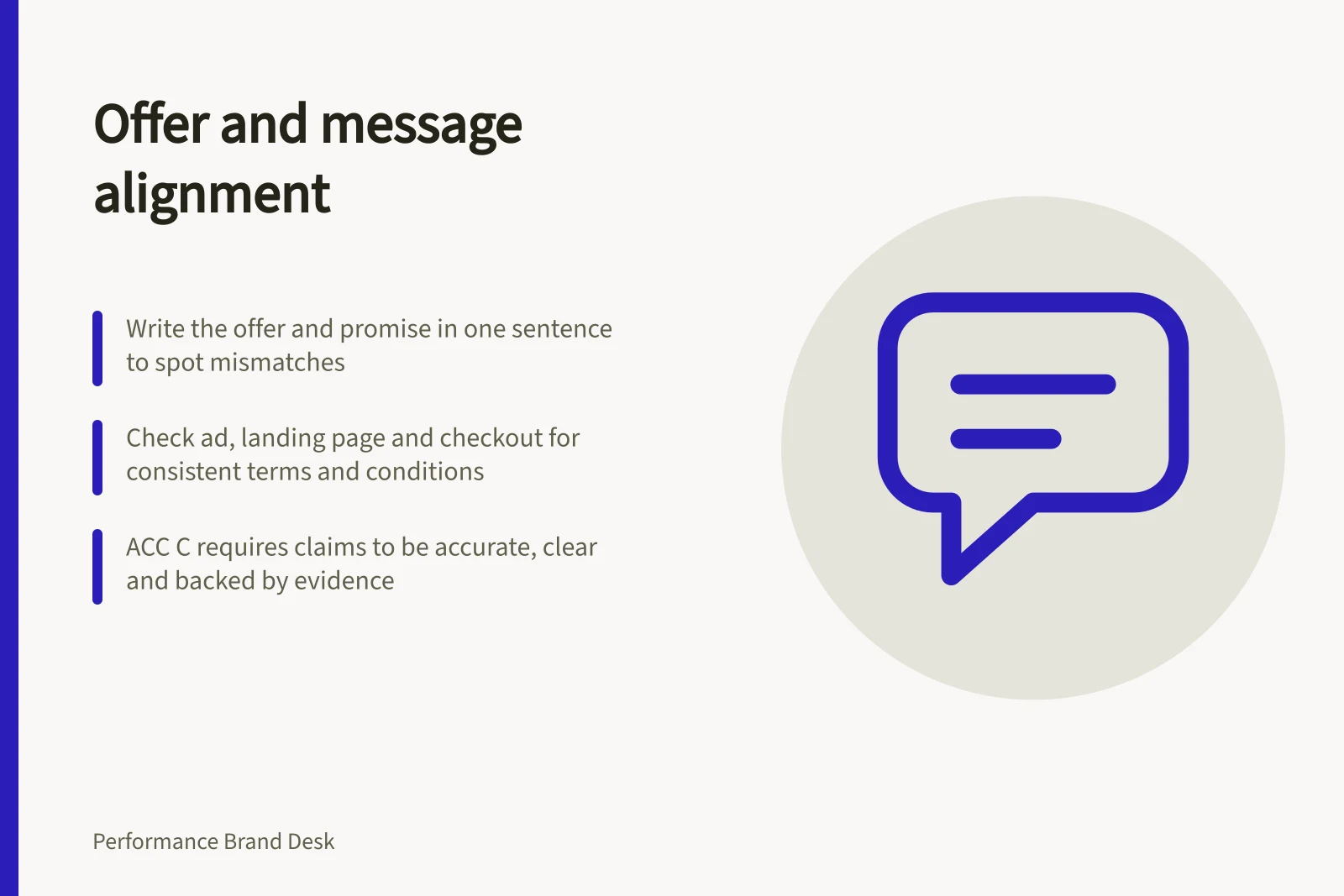
Write the offer in one sentence: the product or service, its main benefit, the price or other commitment, eligibility, and any genuine deadline. Then write the promise a customer would take from the ad. If the sentences differ, identify where the difference appears.
| Signal | Plausible explanation | First check |
|---|---|---|
| People ignore the ad | The audience, creative or benefit may be weak | Compare attention and click patterns by audience and placement |
| People click but leave the page | The page may not deliver the promised benefit | Check headline, offer terms and page load on the actual destination |
| People reach checkout but stop | Price, delivery, trust or terms may be the barrier | Review total cost and the step where exits rise |
Read these prompts as alignment checks, not as proof of a single cause. The ad, landing page and checkout should describe the same offer, terms and conditions. For guidance on telling an offer problem from a weak ad, see the sibling article.
Build a shared campaign brief
Before drafting, agree on the campaign's purpose and the audience it is intended to reach. Set a specific goal, then describe the audience's needs, preferences and behaviours so the offer and its message are shaped for the same customer and outcome.
Turn that agreement into a short brief covering the goal, audience, central message and the actions planned to deliver the campaign. A marketing plan can also record the budget, timeline, resources, channels and tactics.
For each channel, note how the same central message will be expressed there. The wording and format may vary, but the customer should still encounter a consistent account of what the campaign is about and why it is relevant to them.
Keep the message recognisable across channels
A brand voice is the consistent personality and style a business uses in communications, including website content, social posts and customer service emails. Use that voice to make campaign messages recognisable across customer interactions, rather than treating each channel as a separate campaign.
Voice can stay consistent while tone adapts to the context. When adapting a message for a particular channel or interaction, check that its style still feels natural for the business and that the underlying campaign message has not changed.
Make claims reviewable before publication
List the factual claims in the campaign message and identify the evidence that supports each one before publication. The ACCC can require businesses to back up claims about their products or services, so make substantiation part of the review rather than relying on wording alone.
For Australian campaigns, the Australian Consumer Law is relevant to advertising and customer communications. Section 18 prohibits misleading or deceptive conduct, and section 29 prohibits specified false or misleading representations. Advertising claims should be accurate, clear and backed by evidence.
Have the people responsible for the campaign check the message alongside its destination and other customer-facing material. Confirm that the same central proposition is being communicated, and that the information a customer needs to understand it is clear. Keep a record of the claim, supporting evidence and the material reviewed so the decision can be revisited if the campaign changes.
Manage changes with the campaign plan
Check whether a proposed change still serves the agreed goal and audience, and whether the required resources, timing and channels remain part of the plan. A SWOT analysis can also help marketers consider organisational strengths, weaknesses, opportunities and threats when developing the plan.
When reviewing results, relate the proposed adjustment to the campaign objective and audience rather than changing several parts without a clear reason. Changes to messaging, content, budget or marketing channels are possible adjustments; record what changed so the team can keep the campaign coherent as it evolves.
Keep the proposition aligned with the offer
As a final hand-off check, ask someone who did not write the campaign to describe what a customer receives and what they must do to qualify. If their summary differs from the brief, clarify the wording before publication.
In this guide
- Distinguishing an offer problem from a weak adA low response rate does not automatically mean the discount is too small. The ad may be shown to the wrong audience, express the benefit poorly or lead to a …
- Matching a promotion with the brand's value promiseA promotion works best when it gives a customer a reason to choose the business without contradicting the reason they would stay. Before approving a price cut …
- Guide to testing service benefits against price incentives“Better support” and “save now” can attract different customers. A useful test asks which truthful benefit produces a better customer outcome, not simply which version wins more clicks.
- Avoiding urgency claims that the business cannot supportUrgency can help a customer act, but only when the deadline or scarcity is real. A countdown that restarts, an “ending soon” message that runs indefinitely or a …