Brand Positioning
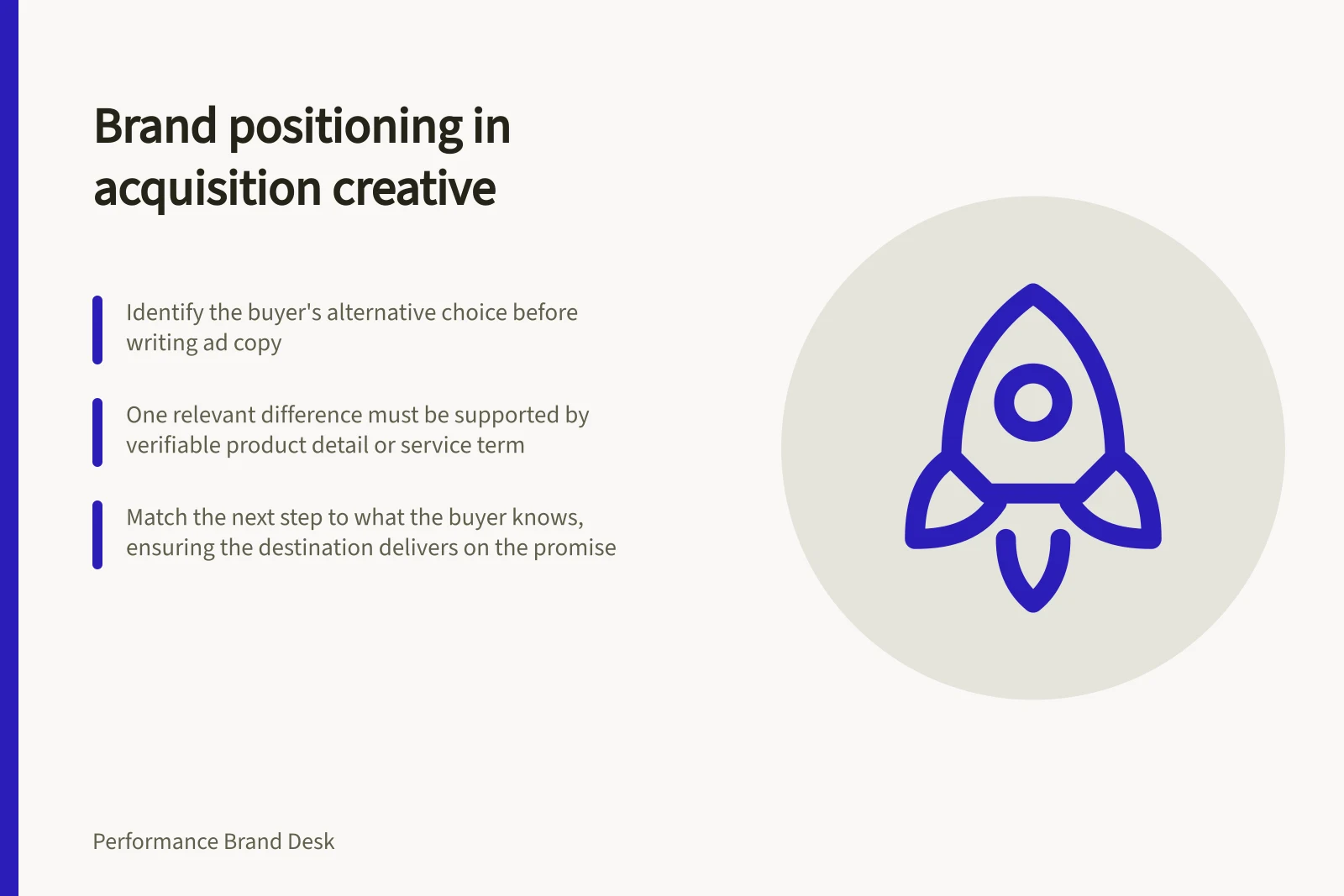
Brand positioning in acquisition creative
Turn a supportable brand difference into acquisition ads that address a buyer’s choice, show relevant evidence and lead to a fitting next step.
Brand positioning gives an acquisition ad a clear reason to be considered. Identify the alternative a buyer is weighing, a difference your business can support, and why that difference matters to this decision. Express one relevant part of that position in the ad.
Start with the choice the buyer faces
Someone may be comparing providers, considering doing the task themselves, or deciding whether to act at all. Name the relevant alternative for the audience before writing copy. A difference helps only if it matters to that choice.
A useful working statement is: “For people choosing between these options, we offer this relevant difference, supported by this evidence.” This is a planning tool, not necessarily ad copy.
Check it against customer, competitor and product research. An internal belief that the business is distinctive is only a starting hypothesis.
| Positioning question | What the ad needs to convey |
|---|---|
| What is the buyer deciding? | A recognisable task, comparison or concern |
| Why consider this business? | One relevant difference |
| Why believe it? | A verifiable product detail, demonstration or service term |
| What can the buyer do next? | A step that lets them inspect or act on the difference |
Ground the choice in market research
Treat the positioning statement as a hypothesis to revisit as you learn more, rather than as a fixed description of what makes the business distinctive.
Decide what you need to learn, then check whether existing research can help. Test whether the proposed difference is relevant to the choice in the ad.
Make market research an ongoing part of business planning and operations. When customer needs, products or competitors change, revisit whether the acquisition message still describes a meaningful reason to choose the business.
Key Regulatory and Research Sources for Australian Brand Positioning
- Market Research Guidance
- Business.gov.au – Do market research
- Advertising Compliance
- ACCC – False or misleading claims
- Survey Design Standards
- ABS – General forms design principles
- Legal Advice on Marketing
- BWS Lawyers – August 2026 Notes (PDF)
Choose a message the placement can carry
Choose a supported difference that matters to this audience. A technical specification may help an informed buyer but need a plain explanation for someone new to the category. A service step may be more useful than a broad promise of convenience when the buyer is unsure what happens after booking.
For a service that displays available appointment windows, an ad could lead with seeing available times before submitting a request, if the booking process really works that way. “Repairs made effortless” would suggest a wider result that the feature alone cannot establish.
Let the words and visual show the relevant detail, identify the business, and point to a page that supplies the information promised. Check the finished ad at its likely displayed size. A condition lost in a crop cannot clarify the main claim.
Check the claim and the next step
Separate what the business can show from what it hopes customers will feel. A screenshot can demonstrate a booking step; it cannot prove that every repair will be quick.
A specification can establish a dimension; it cannot by itself establish superior quality. Keep comparisons within the products and conditions actually examined.
Review the full ad, including imagery and qualifications, to check that the main message is clear and consistent. If a condition materially narrows the promise, make it clear alongside that promise.
Match the next step to what the buyer knows. An unfamiliar service might invite people to inspect how booking works; a clear, available offer might invite them to select a time. The destination should supply the promised detail and explain material eligibility or availability conditions.
For messages that may be unclear, a brief audience check can flag possible confusion; detailed comprehension testing is outside this brief.
A final brief should name the buyer’s decision, the alternative, the approved difference, its evidence, the intended takeaway, the next step and any claim limits.
The ACCC says it can require businesses to back up claims about their products or services. It may investigate misleading claims and take compliance or enforcement action, so retain material that supports the claims used in the finished ad.
In this guide
- Turning a product difference into a clear ad messageTranslate a verified product detail into an ad message that explains its relevance without promising more than the feature can support.
- Replacing generic benefit claims with specific evidenceAudit broad ad benefits, match each likely takeaway to suitable evidence, and write a specific claim with its limits made clear.
- Testing whether a message is understood as intendedUse an unprompted comprehension check to find what people think an ad promises, where they are confused and what to revise.