
Creative Briefing
Part of Creative briefing and feedback
Documenting approved claims for creative teams
Build a production-ready claim record with approved expressions, evidence, coverage, limits and change rules.
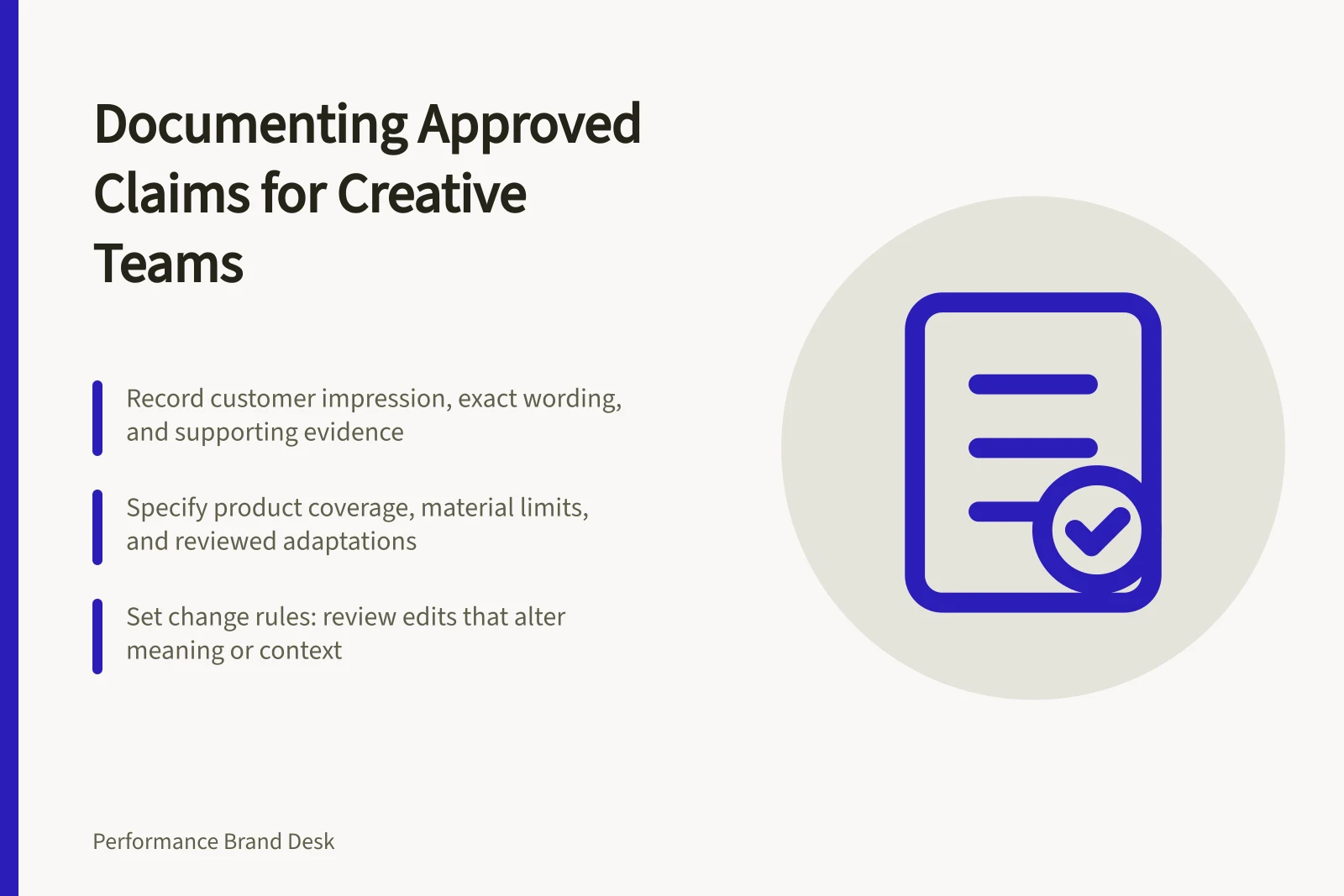
A useful claim record pairs approved wording with intended meaning, supporting evidence, product or service coverage, material limits and owner. It also records which adaptations were reviewed. Without that context, a line labelled “approved” may be reused for an offer or image it no longer describes.
Record the impression as well as the words
Start with the customer impression the team intends to create, then capture the exact wording approved for a particular use. An image of a product being used in rain, for example, could suggest a capability that a narrow caption does not state. Review words and visuals together before recording what the evidence supports.
The ACCC can require businesses to back up claims they make about their products or services. It accepts reports about possible misleading or false claims and may investigate and take compliance or enforcement action. A claim record helps a team apply those principles; it is not proof that every later execution is accurate.
Key benefits of documenting your marketing claims
- ACCC compliance support
- Helps businesses back up claims under Australian consumer law
- Reduced risk of misleading claims
- Clear boundaries prevent unintended interpretations
- Faster production turnaround
- Teams avoid rework with clear guidelines
- Better collaboration across teams
- Designers, marketers and legal teams align on intent
Give production the boundaries it needs
| Field | What to record |
|---|---|
| Approved expression | Exact wording or asset reviewed, and the intended bounded meaning |
| Evidence | The current specification, service rule, demonstration record or other supporting material |
| Coverage | Relevant product version, location, eligibility or dates |
| Material limit | A condition whose omission could change the likely impression |
| Reviewed adaptations | Shorter wording, crops or visual treatments assessed within the same meaning |
| Owner and trigger | Who rechecks the entry when the offer or evidence changes |
Keep a route to the underlying business record for people who need to verify it. Do not expect a designer to infer scope from an unlabelled collection of screenshots. A specification for one model does not automatically cover a product range.
Show where approval stops
Record tempting expressions the evidence does not support when confusion is likely. Listed package dimensions may support an invitation to inspect those dimensions; by themselves they do not support “fits every doorway”. A process that lets customers request an appointment does not establish that every requested time is guaranteed. These are hypothetical distinctions, and a real business must verify its own products and service terms.
A long approved paragraph does not automatically approve a short crop that removes a material condition. If a format cannot carry the condition clearly, narrow the main message or use another treatment.
Set a change rule
State which edits remain within the recorded meaning and which need review. Punctuation may leave the claim intact, but the finished presentation still matters. Adding “all”, introducing a comparison, showing a new use case or switching product versions may change the promise. Review the final words and visuals together even if individual assets were previously approved.
When evidence or terms change, the owner should identify affected live and scheduled assets and their destinations, then amend or pause material that no longer matches. Retain the old entry as a clearly superseded record and direct production to the current one. The final approval note should identify the exact expression reviewed, its evidence version, limits, approver and date.


