Creative Testing
Creative testing programmes
Build a creative testing programme around clear decisions, fair comparisons, meaningful outcomes and a usable record of what each test showed.
A creative testing programme is a repeatable way to decide which advertising ideas deserve more investment. Start with a business question, make a comparison the team can interpret, choose the outcome before launch, then record what the result does and does not support. A calendar full of new ads is not a programme on its own.
Start with decisions
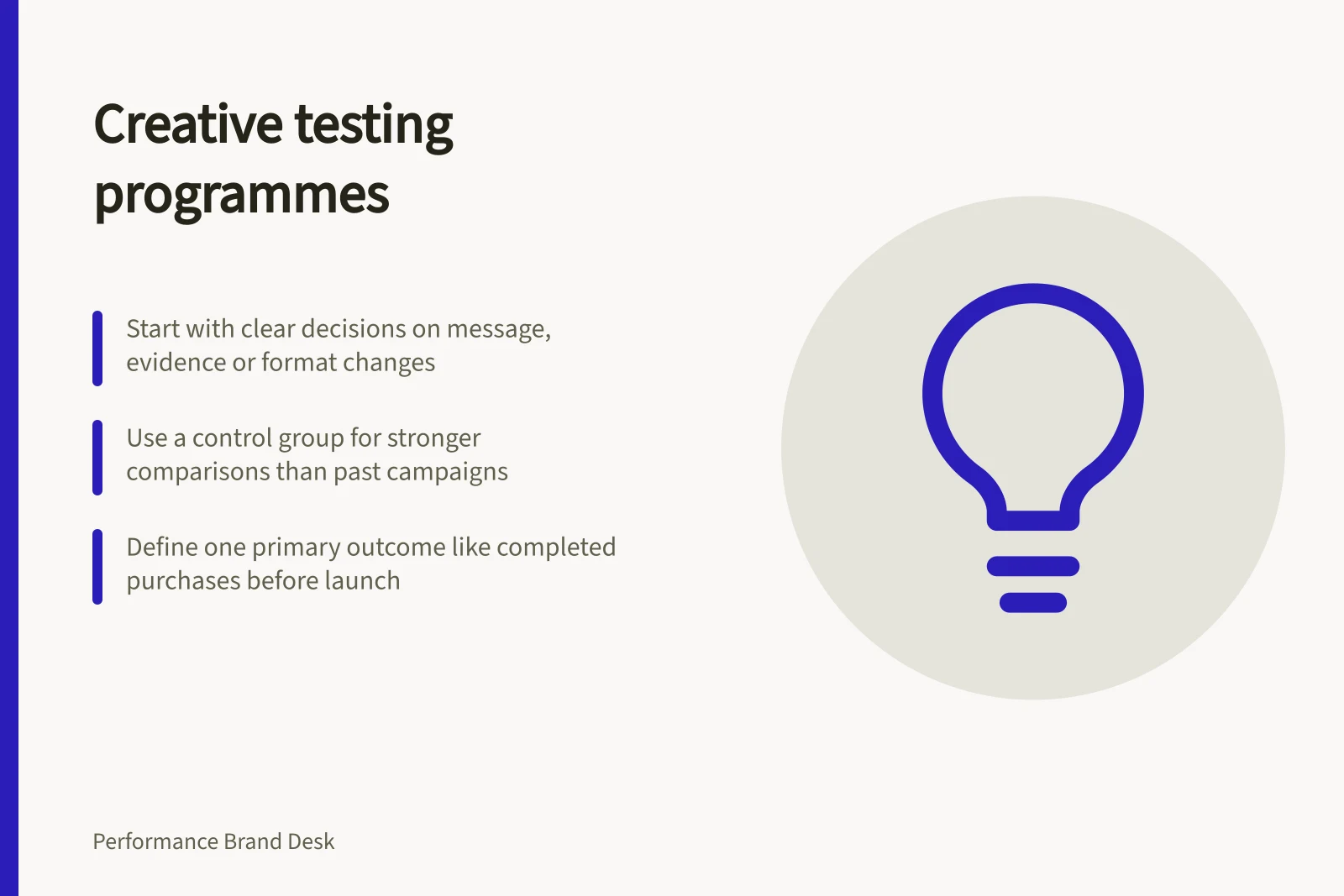
List the decisions the team expects to make: which message to develop, which evidence to show, which format to produce, or whether an existing approach should continue. Prioritise questions that matter to the offer and can be tested with the available audience, budget and conversion volume.
Write each proposed test as a short brief:
- Decision:
- What will change if the result is useful?
- Hypothesis:
- Why might the new creative work better for this audience?
- Difference:
- What changes between the versions?
- Primary outcome:
- Which measure will guide the decision?
- Guardrails:
- What would make an apparent gain unacceptable?
- Boundary:
- Which audience, placement and period will the conclusion cover?
A test with no plausible decision at the end can wait. So can a change the audience may barely notice.
Test Brief Checklist: Ensure Rigorous Design
- DecisionWhat will change if the result is useful?
- HypothesisWhy might the new creative work better for this audience?
- DifferenceWhat changes between the versions?
- Primary OutcomeWhich measure will guide the decision?
- GuardrailsWhat would make an apparent gain unacceptable?
- BoundaryWhich audience, placement and period will the conclusion cover?
Match the design to the question
For a message question, keep the offer and format steady while changing the main idea. For a proof question, keep the promise steady and change the evidence used to support it. A format comparison asks a different question because placement and viewing experience may change with the creative. Plan these as separate rounds unless the team needs to learn about their interaction.
Choose an available experiment method before producing assets. Experiment options and eligible changes depend on the platform, campaign type and account setup. Check these before assuming a particular creative comparison is available.
A control running at the same time gives a stronger comparison than last month's winning ad set against this month's new one. Where a suitable split is unavailable, describe a comparison over time as observational and record changes in audience, spend, seasonality and destination that might explain the result.
Creative Testing: Message vs. Proof vs. Format Questions
- Message QuestionKeep offer and format steady; change main idea.
- Proof QuestionKeep promise steady; change supporting evidence (e.g., testimonials, stats).
- Format QuestionTest different formats (e.g., video vs. static) — requires separate round unless interaction is being studied.
Agree on what success means
Choose one primary outcome close to the decision, such as completed purchases or qualified enquiries. Attention measures can help explain delivery, but a cheaper click is not automatically a better customer. Add a few checks that matter to the offer: conversion quality, revenue or margin where those data are reliable, and complaints or returns where they can be linked to the test.
Set the observation and conversion windows before launch. Recent conversion data can be incomplete when customers act after clicking, so an immediate read may favour the wrong version. Keep the conversion definition the same for both arms. If measurement changes during the test, record it and reconsider whether the comparison remains usable.
Key Metrics for Evaluating Creative Test Success
- Primary Outcome
- Completed purchases or qualified enquiries
- Conversion Quality
- Customer value, revenue, or margin where data are reliable
- Complaints & Returns
- Track issues linked to the test creative
- Observation Window
- Set before launch to avoid incomplete data from delayed conversions
Run a manageable cycle
Maintain a queue of questions rather than launching every idea at once. For each selected test, approve both creatives, check their destinations and claims, document the planned split and duration, and confirm that both versions serve. During the run, watch for broken pages, disapproved assets or unexpected delivery changes. Editing one arm in response to early numbers changes the question being tested.
At review, distinguish evidence favouring a version, evidence of a meaningful downside, and an inconclusive result. An inconclusive result may reflect a small difference, insufficient delivery or imprecise measurement. It does not establish that the versions are equivalent.
Record the decision with the creative files, audience, placement, dates, primary measure, observed result, material deviations, interpretation and next action. The useful output is a bounded instruction for the next brief, not a permanent rule that one headline or image will work everywhere. Revisit a finding when the audience, offer or channel changes substantially.
In this guide
- Planning tests across message, proof and formatSeparate message, proof and format questions so each creative test gives the team a usable answer.
- Choosing a stable comparison for a creative experimentChoose a relevant control, keep campaign conditions steady and record changes that limit a creative experiment.
- Reviewing results beyond the lowest acquisition costReview a creative test using conversion quality, value, timing and uncertainty alongside acquisition cost.
- Recording what a creative test cannot establishDocument a creative test's audience, delivery, measurement and uncertainty so its result is used within its limits.